Description
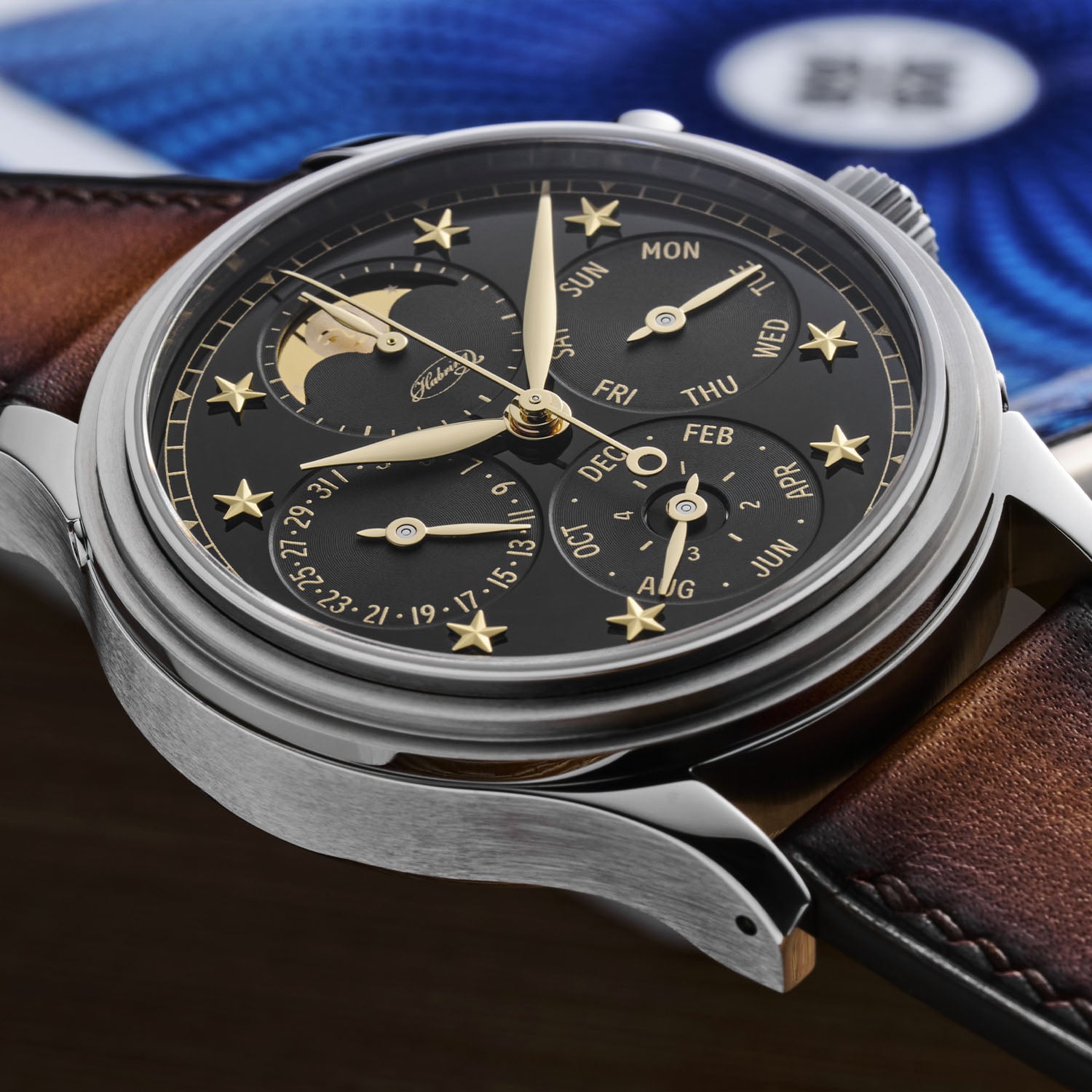
The third and final chapter of the Habring2 and SJX trilogy is also the most ambitious: the Chrono Felix Perpetual Star, a hand-wound monopusher chronograph with a perpetual calendar and moon phase, in a 38.5 mm steel case, limited to 30 individually numbered pieces at USD 28,500 before taxes. It is sold only through SJX, the Singapore watch magazine founded by Su Jiaxian, with deliveries scheduled for January, February and April 2027 in order of placement and a 40 percent deposit at order.
Habring2 is the Austrian workshop of Richard and Maria Habring, the pair behind the first commercially viable Doppelchronograph while Richard was at IWC, and the Chrono Felix Perpetual has been their most complicated series piece since 2022. What this edition adds is a dial: glossy black lacquer with a gilt cast, eight applied gold stars where the hour markers should be, and a frosted gold moon disc at twelve. It is the kind of watch where the complication list and the dial are competing for your attention, which is unusual and mostly works.
Design
The steel case is 38.5 mm across and 13 mm high including the domed, anti-reflective sapphire crystal, finished in a mix of brushing and polishing, with a triple-stepped bezel that hides the recessed calendar correctors in its steps rather than scattering pushers around the caseband. The crown is double-sealed and the caseback is sapphire, with 30 m of water resistance, which is exactly what a hand-wound calendar chronograph needs and no more.
The dial is a glossy black lacquer with a warm gilt tone to the printing, gold-plated markers, hands, tracks and moon disc, and eight applied gold stars standing in for indexes, a nod to the vintage Rolex Galaxy dials of the 1950s; Monochrome attributes the reference specifically to the ref. 6088. Subdials are slightly recessed with a matte concentric finish so they sit behind the gloss rather than on it. The layout puts the moon phase and the 30-minute chronograph counter together at twelve, the date at nine, the day of the week at three, and the month with leap-year indication at six. Hours and minutes are leaf-shaped; the chronograph seconds sweeps from the centre. The strap is patinated brown calfskin on a steel pin buckle decorated, inevitably, with stars.
Specifications
- Reference: not assigned a public reference number
- Case diameter: 38.5 mm
- Case height: 13 mm including crystal
- Case material: stainless steel, brushed and polished, triple-stepped bezel housing the recessed calendar correctors
- Crystal: domed sapphire with anti-reflective treatment
- Caseback: sapphire, individually numbered
- Water resistance: 30 m, double-sealed crown
- Dial: glossy black lacquer with gilt tone, gold-plated markers and hands, eight applied gold stars as hour indexes, frosted gold moon disc, recessed matte concentric subdials
- Movement: Habring2 calibre A11CP, the in-house A11 monopusher chronograph base with a customised Dubois-Depraz perpetual calendar module; 30 mm x 7.3 mm, 21 jewels
- Movement origin: heavily upgraded Valjoux 7750 architecture with most parts now made in-house or by independent suppliers; steel chronograph levers finished by Pohlmann-Bresan
- Complications: monopusher chronograph with central seconds and 30-minute counter, perpetual calendar (date, day of the week, month, leap year), moon phase
- Frequency: 28,800 vph (4 Hz)
- Winding: hand-wound; the crown also sets the day of the week, reducing the number of separate correctors
- Power reserve: 48 hours
- Strap: patinated brown calfskin, steel pin buckle with star decoration
- Limited edition: 30 pieces, individually numbered
- Price: USD 28,500 before taxes, 40 percent down payment at order
- Availability: exclusively from SJX; deliveries January, February and April 2027 in order of placement
What's Exciting
A hand-wound monopusher chronograph with a perpetual calendar and a moon phase, under USD 30,000, from a workshop that builds in the low hundreds of watches a year. Put that sentence next to what the Swiss majors charge for a perpetual chronograph and the value argument makes itself. The more interesting detail is the crown doing double duty as the day-of-week corrector: perpetual calendars usually punish you with a row of pushers, and Habring2 has cut that count down by making the parts it needs rather than accepting what the module came with. This is what people mean when they call the A11 a 7750 derivative and then add that almost nothing of the 7750 is left.
The dial choice is the risk and the reward. Eight applied gold stars on black lacquer is a 1950s Rolex idea, and dropping it onto a calendar chronograph with four subdial functions could easily have turned into noise. It does not, because the stars sit on the gloss and the registers sit behind it, and the gilt palette ties the two planes together. Whether a 30-piece run priced in dollars and sold by a magazine counts as a watch brand or a publishing project is a fair question, and the answer is that the trilogy has produced three watches nobody else would have commissioned.
History
Richard Habring developed the module that became IWC's Doppelchronograph in the early 1990s, the first split-seconds chronograph that could be made in series at a sane price. He and Maria Habring founded their own workshop in Volkermarkt, Austria, and have spent two decades rebuilding the Valjoux 7750 into something they own: the A11 family, with in-house or independently sourced components, their own escapement work, and a monopusher execution that is the house signature.
The SJX collaboration began in 2021 with the Erwin Star, which introduced the applied-star dial. The second piece, the Chrono-Felix Medicus, brought the monopusher chronograph format and the gilt dial treatment. This third and final watch combines both and adds the perpetual calendar, closing a trilogy that was planned as three from the start. The Chrono Felix Perpetual itself was introduced in 2022; the Star is its most decorated version and, with the trilogy complete, the last of the line in this form.