Description
Girard-Perregaux has become official timing partner of the Atlassian Williams Racing Formula 1 team, and these are the first two watches from that agreement: a Laureato Williams Edition and a Laureato Chronograph Williams Edition, both 42 mm in stainless steel, both dressed in the electric blue of the 2026 FW48 car. They arrive on 19 October 2026 at US$16,200 and US$20,900.
The notable decision is what these are not. Neither model is a limited edition. Motorsport partnerships in watchmaking almost always arrive capped at some number tied to a race distance or a championship year; Girard-Perregaux has instead put the Williams editions into the regular Laureato catalogue, which reads as a statement that this is a long partnership rather than a single drop.
Mechanically these are standard Laureatos, which is the point — GP01800 in the time-and-date, GP03300 in the chronograph, both manufacture calibres finished to the standard the Laureato has held since its 2016 revival.
Design
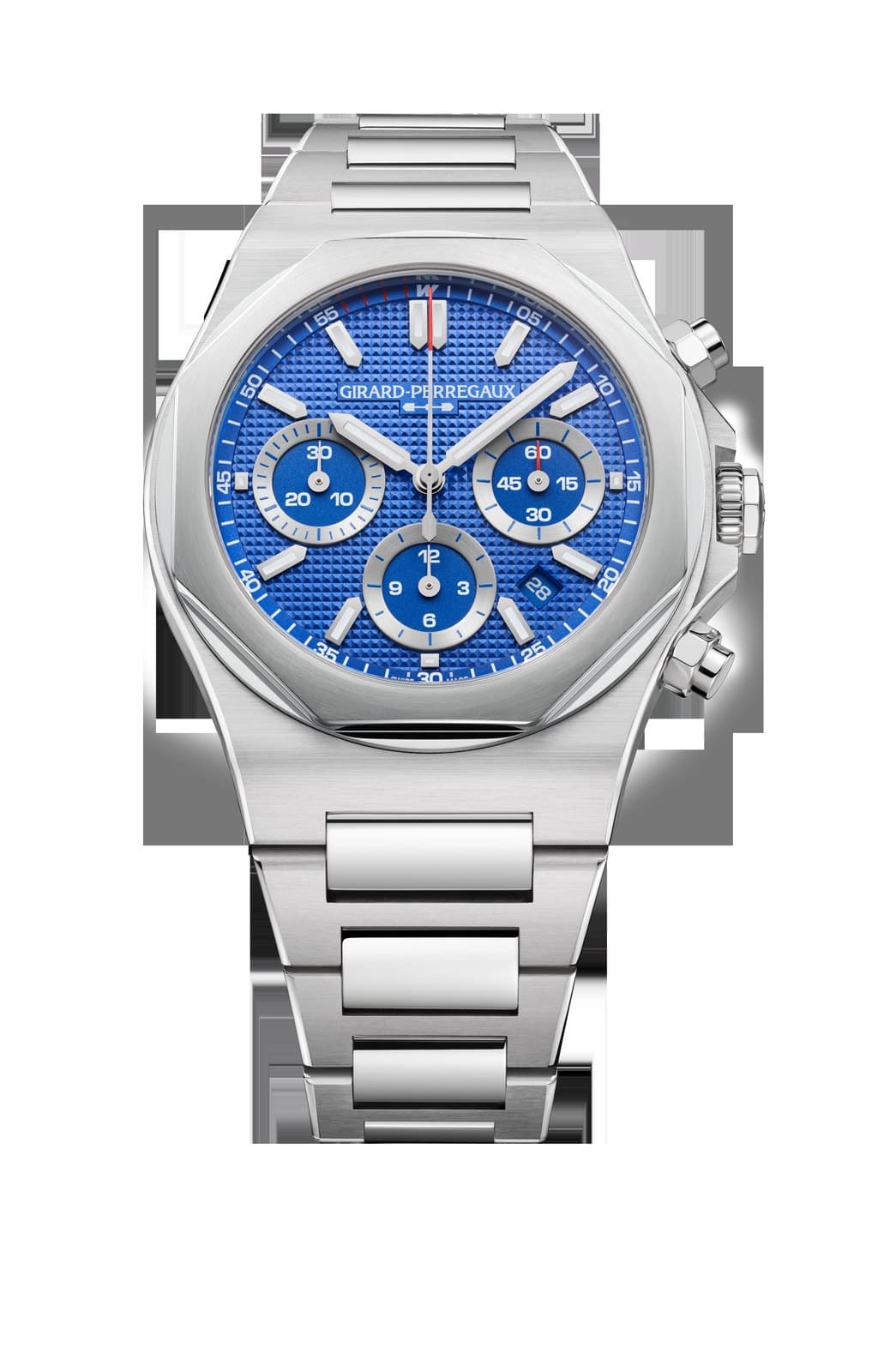
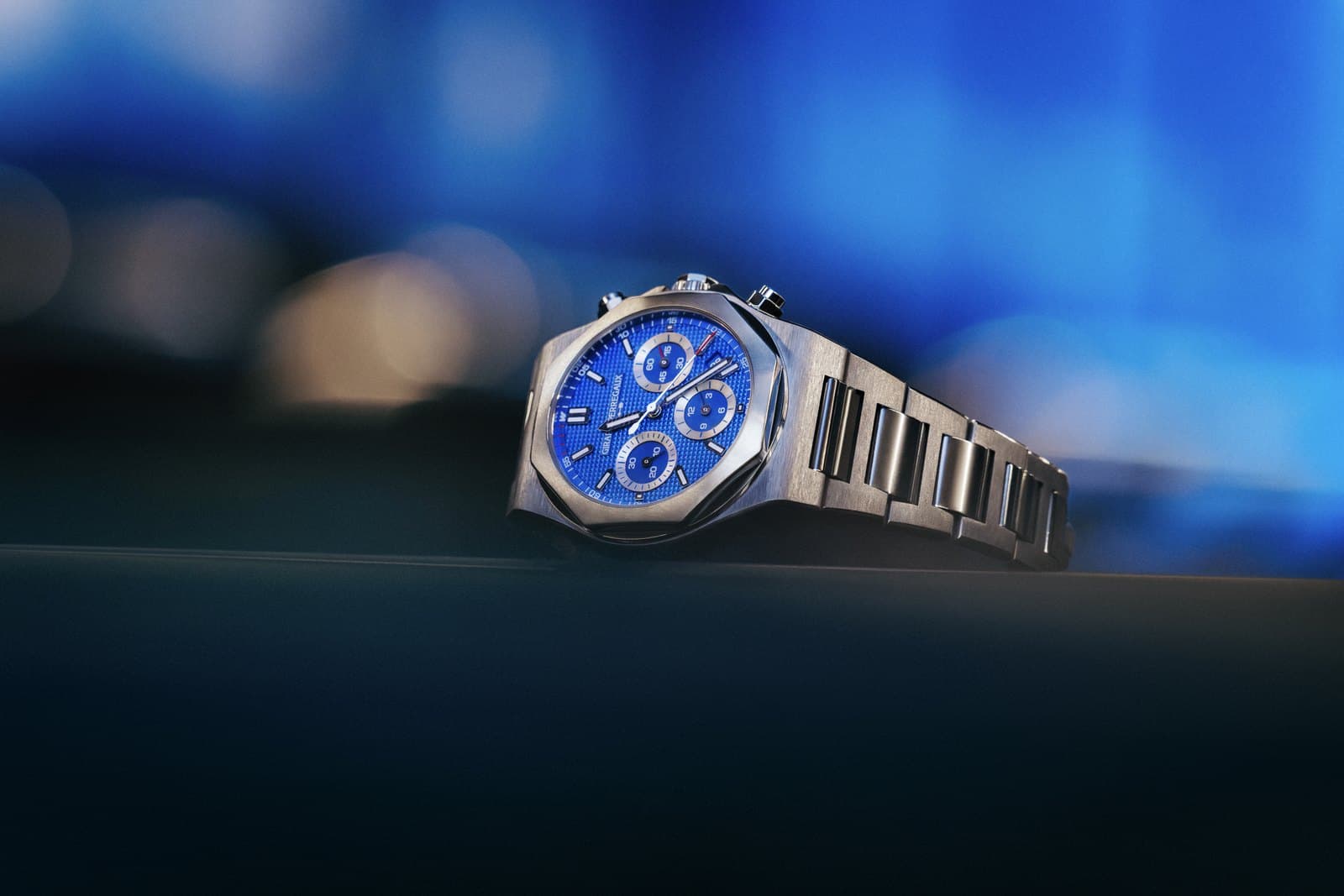
Both dials are electric blue with Girard-Perregaux's Clous de Paris hobnail pattern, the texture the Laureato has carried since 1975, here in a saturated racing blue rather than the brand's usual navy. Red accents lifted from the Williams livery run through the dial furniture, and the Williams "W" sits above twelve where a secondary signature usually would. On the chronograph, the three subdial surrounds are rhodium-finished, which stops the blue from flattening out.
The cases are the familiar Laureato architecture: an octagonal bezel on a round case on a tonneau-shaped midcase, with the integrated bracelet flowing straight out of the lugs. Surfaces alternate between satin brushing on the bracelet links and case top and polished bevels down the flanks. The time-and-date measures 10.68 mm thick and the chronograph 12.16 mm — both slim for 42 mm. Casebacks are sapphire with a metallized Williams F1 logo, showing Cotes de Geneve striping on the movements underneath, and water resistance is 100 m on both.
Specifications
- References: 81010-11-3680-1GM (Laureato Williams Edition) and 81020-11-3681-1GM (Laureato Chronograph Williams Edition)
- Case diameter: 42 mm, both models
- Case thickness: 10.68 mm (time-and-date) / 12.16 mm (chronograph)
- Case material: Stainless steel
- Bezel: Octagonal, polished and satin-brushed
- Crystal: Sapphire, anti-reflective
- Caseback: Sapphire with metallized Williams F1 logo
- Water resistance: 100 m, both models
- Dial: Electric blue Clous de Paris with red accents; Williams "W" above 12 o'clock; rhodium subdial surrounds on the chronograph
- Movement: Girard-Perregaux GP01800 selfwinding (time-and-date) / Girard-Perregaux GP03300 selfwinding chronograph
- Complications: Hours, minutes, seconds and date / chronograph with date
- Frequency: 28,800 vph (4 Hz), both movements
- Winding: Automatic, both
- Power reserve: 54 hours (GP01800) / 46 hours (GP03300)
- Finishing: Cotes de Geneve striping, visible through the caseback
- Bracelet: Integrated stainless steel with triple folding clasp
- Limited edition: No — both are regular catalogue references
- Price: US$16,200 / GBP 12,800 (time-and-date); US$20,900 / GBP 16,500 (chronograph)
- Availability: From 19 October 2026
What's Exciting
The Laureato is the value argument in the integrated-bracelet category and nobody says it loudly enough. A design in the same conversation as the Royal Oak, from a manufacture that has been making its own movements since 1791, with an in-house automatic, Cotes de Geneve finishing and a sapphire back, at US$16,200 — the nearest comparable pieces from the two brands everyone names first start at roughly double that and carry multi-year waiting lists. GP03300 in particular is an underrated chronograph movement: an integrated automatic chronograph with a column wheel at a price where most competitors fit a modular chronograph stack on top of a base calibre.
Leaving both references unlimited is the right call and a slightly brave one, because scarcity is the easy lever in a motorsport tie-in. It means a Williams fan who wants the watch in 2028 can still buy one, and it removes the aftermarket speculation that usually swallows Formula 1 collaborations in the first fortnight. The red-on-electric-blue palette is loud by Laureato standards; whether it still looks good in five years is the open question, but the Clous de Paris dial gives it more depth than a flat racing-livery colour block would.
History
Girard-Perregaux is one of the oldest continuously operating Swiss manufactures, tracing to 1791, and the Laureato dates to 1975 — three years after the Royal Oak, two after the Nautilus, making it the third of the original integrated-bracelet luxury sports watches and the one most often forgotten in that conversation. The first Laureato was quartz, running Girard-Perregaux's own high-frequency calibre; it went mechanical in 1995, faded from the catalogue, and was fully revived in 2016 for the manufacture's 225th anniversary.
The Williams partnership is new ground in one sense and familiar in another. Girard-Perregaux already builds motorsport editions in the Laureato Absolute line, which exists precisely to carry that kind of collaboration. Putting Williams colours on the classic steel Laureato rather than the Absolute is the more interesting choice: it dresses the dress-sports watch in racing colours instead of building yet another carbon-and-rubber special.