Description
Girard-Perregaux has moved its Three Gold Bridges tourbillon into the permanent Laureato catalogue. The Laureato Fifty Three Gold Bridges, ref. 99112-58-3619-1CM, puts the manufacture's 160-year-old bridge architecture inside a 41 mm steel sports watch on an integrated bracelet, and unlike the 2025 version it is not a limited edition. You order it. At EUR 178,000, CHF 162,000 or USD 182,000 it is priced identically to the limited run it replaces.
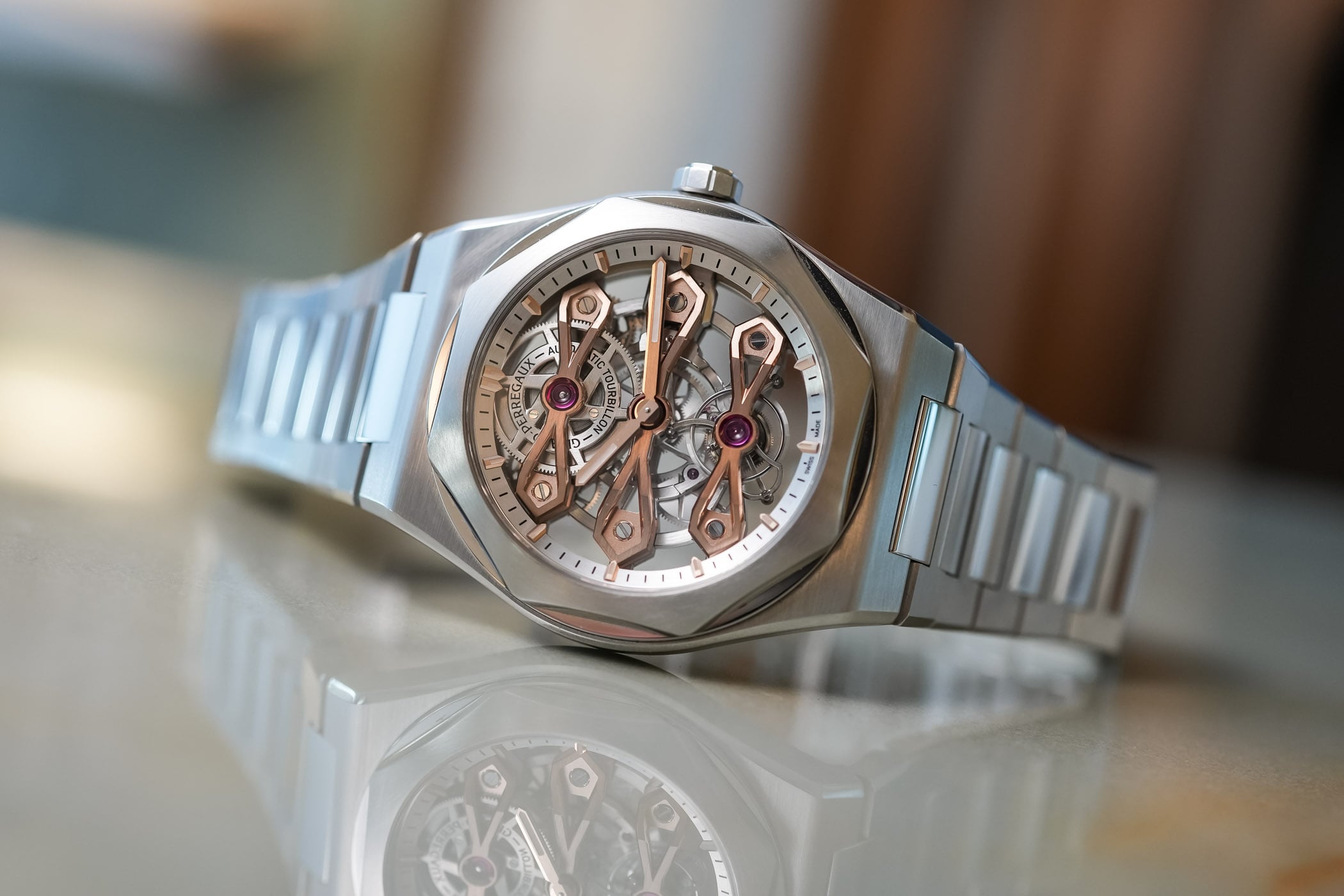
The headline change is metallurgical. The three arrow-shaped Neo Bridges are now solid rose gold where the 2025 edition used white gold, and the dial picks that up with applied rose gold hour markers and rose gold-toned hands. Water resistance also moves from 30 m to 50 m. Everything else that made the watch interesting is intact, starting with the fact that a steel-cased tourbillon on a bracelet measures 10.85 mm thick.
Design
The middle case and caseback are stainless steel, vertically brushed across the top surfaces with polished lateral bevels, and the octagonal bezel is 18k white gold seated on a circular plinth, so the two-metal reading stays quiet rather than announcing itself. That white gold bezel against rose gold bridges is an unusual pairing and it is the deliberate point of the watch: the cool metal frames the case, the warm metal carries the movement.
The dial is openworked, with a sloped flange holding the applied rose gold markers and the minute track, and pencil hands in a rose gold tone with Super-LumiNova inserts. Through the opening you see the exposed barrel and the platinum micro-rotor at twelve and the one-minute tourbillon at six, all three held under the arrow-shaped bridges that give the watch its name. The integrated steel bracelet closes on a triple-folding clasp with up to 4 mm of fine adjustment, which on a watch at this price is a courtesy more brands should extend.
Specifications
- Reference: 99112-58-3619-1CM
- Case diameter: 41 mm
- Case thickness: 10.85 mm
- Case material: stainless steel middle case and caseback, vertically brushed with polished lateral bevels
- Bezel: 18k white gold, octagonal, on a circular plinth
- Water resistance: 50 m (up from 30 m on the 2025 limited edition)
- Dial: openworked, sloped flange with applied rose gold hour markers and minute track, rose gold-toned pencil hands with Super-LumiNova, exposed barrel and micro-rotor at 12, exposed tourbillon at 6
- Bridges: three arrow-shaped Neo Bridges in solid rose gold (white gold on the 2025 edition)
- Movement: calibre GP9620-2856, in-house, automatic
- Complications: one-minute tourbillon
- Winding: automatic, platinum micro-rotor
- Frequency: 21,600 vph (3 Hz)
- Power reserve: 55 hours
- Components and jewels: 303 components, 33 jewels
- Bracelet: integrated stainless steel, triple-folding clasp with up to 4 mm fine adjustment
- Limited edition: no, permanent collection
- Price: EUR 178,000 / CHF 162,000 / USD 182,000
- Availability: announced 28 October 2026, permanent collection
What's Exciting
The micro-rotor is the whole watch. A full-size oscillating weight would have cost two or three millimetres of height, and at 13 or 14 mm this would be just another thick tourbillon on a bracelet. At 10.85 mm it wears like a Laureato, which is the only reason to build a Laureato in the first place. Girard-Perregaux spent the complexity on the winding system in order to buy back the thickness, and that is engineering serving design rather than the other way round.
The second thing worth saying is that it is not limited. Girard-Perregaux owns one of the few genuinely proprietary visual signatures in watchmaking, the three parallel bridges it has been building since the 1860s, and it has chosen to put that signature into its steel sports watch as a catalogue model rather than a 2025-style scarcity exercise. At this price that is not an accessibility argument, but it is a statement about confidence in the product. The rose gold bridges are the right call too: against a white gold bezel the warm movement metal reads as the subject of the watch.
History
Girard-Perregaux's three parallel bridges date to the 1860s, when Constant Girard laid out the barrel, gear train and escapement of a pocket watch under three symmetrical arrow-shaped bridges and then, in an unusual move for the period, made them the visible face of the watch rather than hiding them behind a dial. The Tourbillon with Three Gold Bridges won awards at the Paris Universal Exhibitions and became the house's defining object; it has been revived repeatedly, most prominently in the 1980s and again in the 2010s.
The Laureato arrived in 1975, an integrated-bracelet steel sports watch with an octagonal bezel, designed in the Gerald-Genta-era idiom but by an architect commissioned through a Milanese studio. The line was relaunched in full in 2016 and has since absorbed almost every complication the manufacture builds. The Laureato Fifty collection marked the model's fiftieth anniversary in 2025, and this is the watch that brings the two house signatures, the Laureato case and the Three Gold Bridges, together permanently.