Description
L. Leroy doesn't make news often. The Paris-born maison, founded in 1785 by Basile Charles Le Roy, has spent more time in dormancy over the last fifty years than in active production — but when it does move, it moves seriously. The new Elyor Flying Tourbillon is the second new release of the brand's current revival, following the Osmior Bal du Temps tourbillon-minute-repeater of 2025, and it is by far the most consequential. For the first time in 240 years of recorded company history, an L. Leroy calibre uses a micro-rotor.
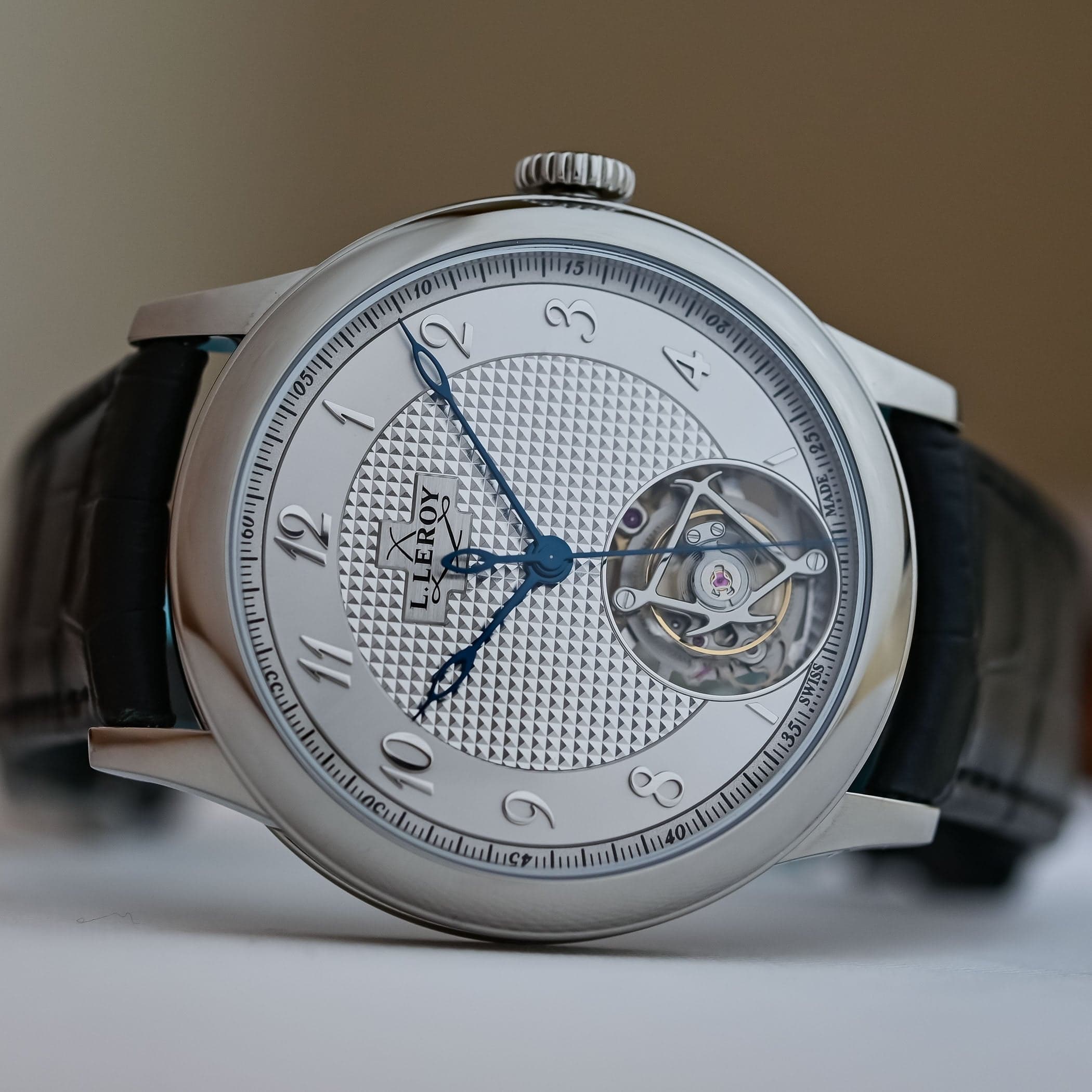
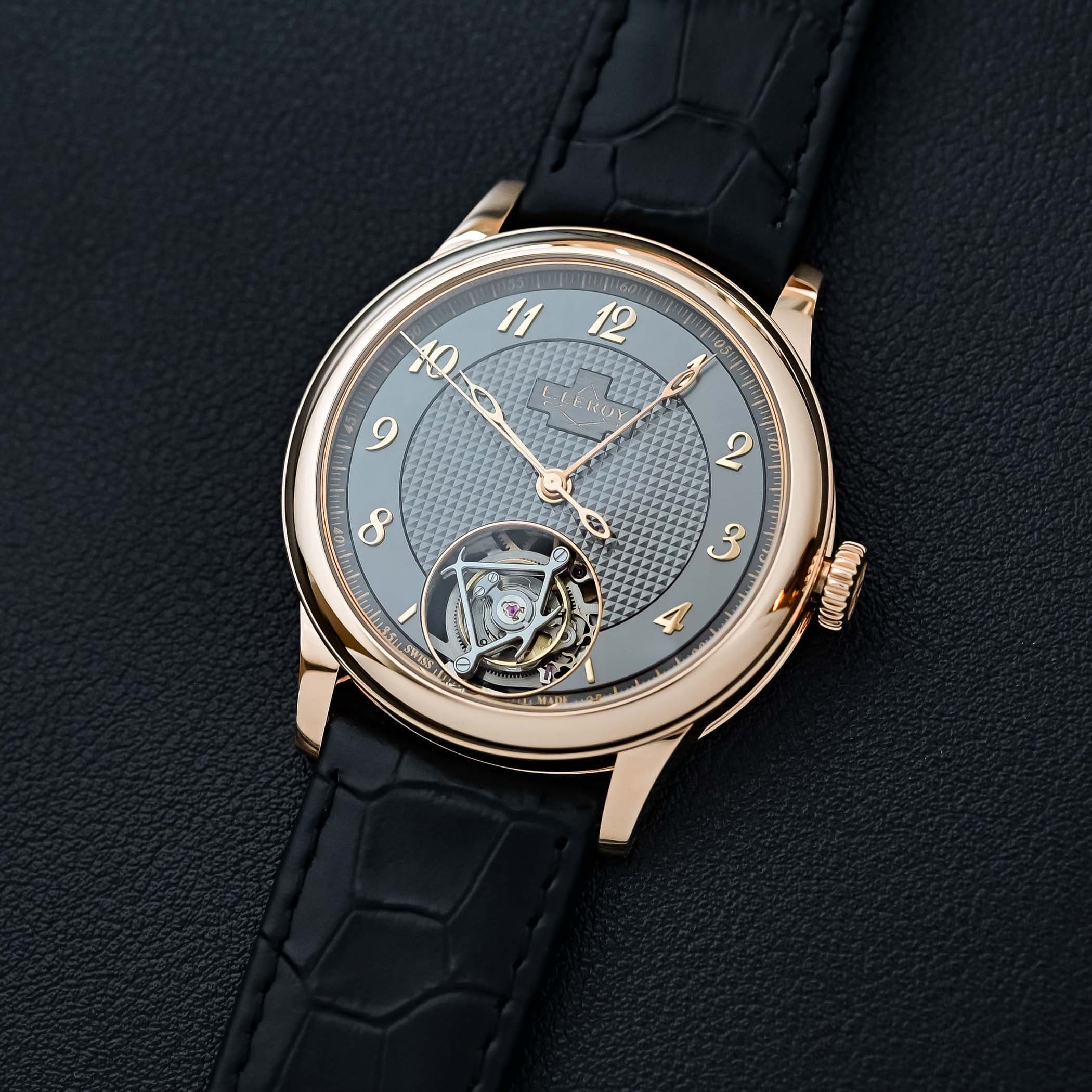
The Elyor is a 42 mm tambour-cased, three-metal flying tourbillon released simultaneously in grade 5 titanium (Ref. LL311/1), platinum 950 (Ref. LL310/1), and 18k 5N rose gold (Ref. LL309/1). Each metal carries its own dial colour: silver for titanium, an ALD-treated sky-blue for platinum, and an anthracite-with-gold-accents reading for the 5N. The flying tourbillon sits at 6 o'clock under a titanium bridge cut into the brand's interlaced double-L monogram. The seconds are central — a layout familiar from observatory chronometers and a hat-tip to L. Leroy's heritage as a supplier to the Paris Observatory.
The name "Elyor" itself is no marketing flourish. During the Reign of Terror (1793–1794), the maison signed its watches under the anagram of "Leroy" to escape the wave of revolutionary violence that targeted anyone associated with the deposed royal court. Two and a half centuries later, the brand has chosen to make that disguised name the face of its most ambitious modern release — a quiet act of historical restoration that says rather a lot about how seriously L. Leroy is taking its second life.
Design
The case is a tambour shape — 42 mm in diameter, 9.90 mm thick (11.88 mm including the domed sapphire crystal) — a deliberate rejection of the round-case norm that dominates the contemporary high-end tourbillon segment. The proportions are surprisingly wearable for a fully-cased flying tourbillon at this technical level, and the tambour profile gives the watch a more architectural, less obviously dressy character on the wrist.
Each metal version pairs to a single dial execution: the titanium Ref. LL311/1 wears a brushed silver dial; the platinum Ref. LL310/1 wears an ALD-treated sky-blue; the 18k 5N gold Ref. LL309/1 wears anthracite with 5N gold accents. The flying tourbillon aperture at 6 o'clock is the dial's structural anchor; the cage is topped by a grade 5 titanium bridge that has been cut into the maison's interlaced double-L monogram, framing the tourbillon's complete one-minute rotation. Indices are applied, hands are dauphine in style, and the central seconds hand keeps the dial discipline closer to a chronometer than to a typical decorative tourbillon. The display caseback shows the new automatic calibre with its gilded Inermet (tungsten-based) micro-rotor finished in geometric satin with a raised polished L. Leroy logo.
Specifications
- References: LL309/1 (18k 5N gold, anthracite dial), LL310/1 (Platinum 950, ALD-treated sky-blue dial), LL311/1 (Grade 5 titanium, silver dial)
- Case shape & size: Tambour, 42 mm × 9.90 mm (11.88 mm with sapphire crystal)
- Materials: Grade 5 titanium / Platinum 950 / 18k 5N gold
- Bezel: Smooth, integrated to the tambour case
- Crystal: Domed sapphire, anti-reflective coating; sapphire display caseback
- Dial: Three executions — silver (Ti), ALD-treated sky-blue (Pt), anthracite with 5N gold accents (Au); flying tourbillon aperture at 6 o'clock; central seconds; applied indices; dauphine hands
- Movement: L. Leroy proprietary self-winding flying tourbillon calibre — first-ever micro-rotor in the brand's history (gilded Inermet — tungsten-based alloy — rotor with satin geometric decoration and raised polished logo)
- Escapement: Swiss lever; flying tourbillon at 6 o'clock
- Frequency: 3 Hz (21,600 vph)
- Power reserve: 60 hours
- Water resistance: 30 m (dress class)
- Strap: Hand-stitched alligator with metal-matched pin buckle
- Price: POA (Price on Application) — distributed via L. Leroy boutique and select retailers (e.g., Cellini Jewelers, NYC)
- Availability: From late April / Q2 2026, small-series production
What's Exciting
The headline isn't the tourbillon itself — flying tourbillons in this segment are a finished engineering problem. The headline is the micro-rotor. For 240 years of recorded operation L. Leroy has not produced a self-winding micro-rotor calibre. The Elyor is the brand's first, and it is an own-development designed for L. Leroy in Geneva, finished and assembled with the level of decoration you'd expect at this metal-and-tourbillon price tier. Pairing a flying tourbillon with a micro-rotor is mechanically the more difficult choice (the rotor mass envelope competes with the tourbillon cage geometry), but it lets L. Leroy keep the case under 10 mm thick — a meaningful number for a fully-automatic tourbillon dress watch.
The second exciting angle is the three-metal, single-design release. The titanium version in particular widens the audience considerably: a flying-tourbillon dress piece in grade 5 Ti with central seconds, 60 hours of reserve, and a fully proprietary movement is exactly the kind of release that a reborn historic brand uses to talk to a younger audience without pushing the platinum-and-gold buyer away. And the tambour case differentiates the Elyor sharply from the round-case tourbillons that fill this segment.
History
L. Leroy traces its origin to 1785 in Paris, when Basile Charles Le Roy opened his workshop and quickly became one of the official suppliers to the French royal court. During the Reign of Terror (1793–1794), the workshop signed its pieces under the anagram "Elyor" to evade revolutionary persecution — a survival tactic that turned out to be one of the more colourful working-period episodes in horological history. In the 19th century, under the direction of Louis Leroy, the firm became one of the most decorated French chronometer-makers, producing observatory chronometers for the Paris Observatory, marine timekeepers for the French Navy, and travel watches for figures including Queen Victoria and Tsar Nicholas II. The legendary L. Leroy 01 of 1900 — a 24-complication pocket watch — was, at the time, the most complicated portable timepiece ever made.
The brand fell into commercial dormancy across most of the 20th century. The current revival began in earnest in 2024–2025 with the Osmior Bal du Temps minute-repeater tourbillon, and the Elyor is the second new release of that revival arc. Naming this generation of L. Leroy tourbillons after the brand's revolutionary-period pseudonym is a deliberate choice: the modern Elyor is, in effect, L. Leroy's signature returning under its disguise — a 240-year-old secret name now wearing the brand's first-ever micro-rotor.
Sources
- Monochrome Watches — Hands-On: Chapter Two in the Revival of L. Leroy with the New Elyor Flying Tourbillon
- WatchTime — L.Leroy Introduces the Elyor Tourbillon
- Deployant — New and Reviewed: L. Leroy Elyor Tourbillon
- Watch Collecting Lifestyle — Introducing: L. Leroy Elyor Tourbillon Seconde Centrale (Live Photos)
- Europa Star — L.Leroy Elyor Tourbillon: Honouring Centuries of Excellence
- L. Leroy — Official Site