Description
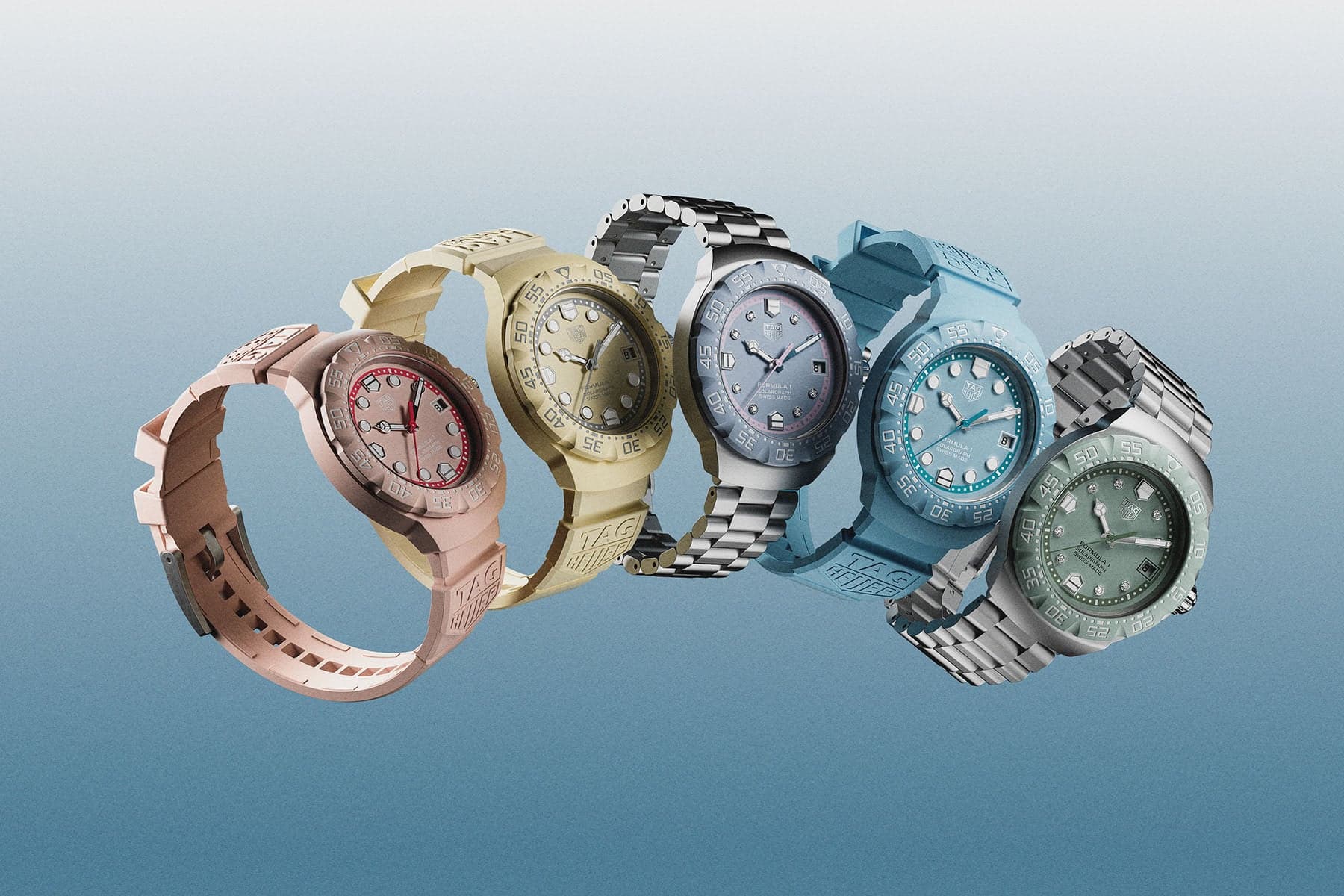
TAG Heuer is dropping a five-piece pastel capsule of its Formula 1 Solargraph 38mm collection, timed exactly to the 2026 Miami Grand Prix weekend. Pre-sales open at 03:00 EDT on April 28, 2026 — making this one of the rare Swiss watch launches built around an e-commerce ticker rather than a press conference. The lineup combines TAG's proprietary Polylight bio-polyamide case material in pastel blue, beige, and pink with two diamond-set stainless steel references in pastel green and lavender, all powered by the in-house Caliber TH50-00 Solargraph introduced last year.
This is Miami-energy distilled into a sub-USD 3,000 watch: pastel dials, light-feedback solar charging, FKM rubber straps colour-matched to the cases, and limited production runs that range from 1,000 pieces (the lavender) to 3,500 (the beige). For a watch line that lost its way through the 2010s with bloated 43mm chronographs, this five-reference reboot at 38mm feels like the most considered F1 launch in two decades.
It's pitched squarely at younger buyers and at returning fans of the original 1980s F1 — a true everyday quartz that asks for nothing but light, glances, and a few wrist-rolls under the Florida sun.
Design
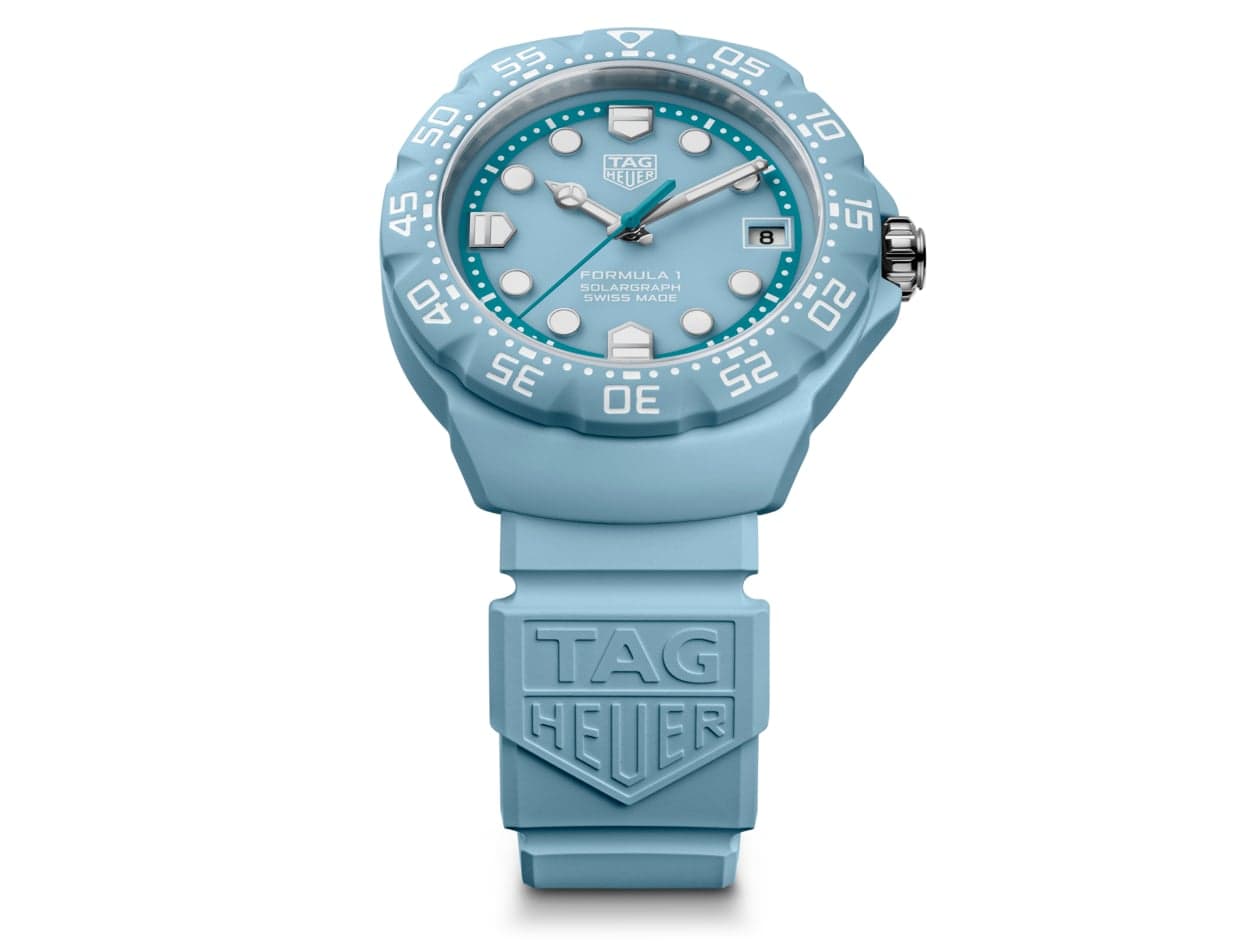
The 38mm × 9.9mm case sits comfortably between vintage and modern proportions. Three of the five references — pastel blue (WBY1164.FT8114), pastel pink (WBY1163.FT8113), and beige opaline (WBY1165.FT8115) — use TAG Heuer's Polylight, a proprietary bio-polyamide that is lighter than aluminium and softer-feeling than polished steel. Each Polylight case comes paired to a colour-matched FKM rubber strap with the F1 grid pattern moulded along the edges.
The remaining two references step up the materials: a sandblasted stainless steel case finished with diamond hour markers, available in either a pastel green dial or lavender-blue dial. These are the connoisseur picks of the capsule, and the lavender (LE 1,000) is the rarest reference of the entire line.
The dial layout stays faithful to the original 1986 F1 codes: rhodium-plated applied indexes, oversized shield-shaped hour markers at 12, 3, 6 and 9, a date window at 6 o'clock, and a centre seconds hand. The bi-directional bezel — Polylight or steel, matching the case — carries a 60-minute scale picked out in white. The dials use a fine sunray brush in their respective pastel hue, and the rhodium-coated handset is filled with white SuperLumiNova for clean low-light legibility.
Specifications
- References: WBY1163.FT8113 (pink Polylight), WBY1164.FT8114 (blue Polylight), WBY1165.FT8115 (beige Polylight), plus two diamond-set steel references (lavender, green)
- Case size: 38mm diameter × 9.9mm thick
- Case material: TH-Polylight (bio-polyamide) for three refs; sandblasted stainless steel for two refs
- Bezel: Bi-directional, matching case material, 60-minute scale
- Crystal: Sapphire with internal anti-reflective coating
- Dial: Sunray pastel (blue / pink / beige / green / lavender), rhodium-plated indexes
- Movement: Caliber TH50-00 Solargraph (in-house, solar-powered quartz)
- Energy: 1 minute of direct sunlight = 1 day of operation; full charge = up to 10 months autonomy
- Functions: Hours, minutes, central seconds, date at 6, end-of-life indicator
- Water resistance: 200 m
- Strap/bracelet: Colour-matched FKM rubber (Polylight refs); steel bracelet (steel refs)
- Limited edition: Beige 3,500 / Blue 3,000 / Pink 2,500 / Green 1,500 / Lavender 1,000 pieces
- Price: USD 1,950 (Polylight, rubber strap) / USD 2,800 (steel, diamond markers)
- Availability: Pre-sales open April 28, 2026 at 03:00 EDT via TAG Heuer e-commerce
What's Exciting
The most exciting thing about this capsule is what it represents for TAG Heuer's strategic direction. Solargraph technology — first deployed in the F1 line in 2025 — turns the watch into a maintenance-free everyday tool: no battery changes, no charging cables, no special handling. Combined with the Polylight case (lighter and more comfortable than steel), this is engineered to be the F1 you actually wear every day, not the one that sits in a winder. At USD 1,950, it undercuts almost every modern Swiss alternative in the same size and water-resistance class.
Limited-edition production caps — 1,000 lavender, 1,500 green, 2,500 pink, 3,000 blue, 3,500 beige — guarantee genuine scarcity even on the higher-volume colours, and the diamond-set steel models add a luxury angle that the F1 line has never seriously attempted before. The lavender at 1,000 pieces is going to be the long-term collector pick of the capsule.
History
The TAG Heuer Formula 1 launched in 1986 as the first quartz timepiece designed to make the brand accessible to a younger, sportier audience. The original line — fibreglass-and-steel cases at 35mm with brightly-coloured dials — became a cultural icon of the late-1980s motorsport era and put TAG Heuer (then Heuer-Léonidas) firmly back on the high-street watch map. By the 2000s, the F1 had grown into 41–43mm chronograph territory and had largely lost the playful spirit of the original.
The 2025 reintroduction of a 38mm three-hand F1 with the Solargraph technology was the first serious attempt to recapture that 1986 spirit. The 2026 Miami Pastel capsule is the follow-up: same proportions, same solar concept, but now expressed in a colour palette that explicitly references the South Beach culture surrounding the F1 Miami Grand Prix — and with limited-edition production caps that retroactively position the 38mm Solargraph as a collectible line, not just a heritage reissue. Pre-sales opening at 03:00 EDT on Grand Prix race weekend is a deliberate signal that TAG Heuer wants this to be a buyable, talked-about, ticker-driven launch rather than a quiet boutique drop.
Sources
- Fratello — TAG Heuer Brings Miami To Your Wrist With The Formula 1 Solargraph Pastel Collection
- Robb Report — TAG Heuer Just Unveiled Its New Pastel Formula 1 Solargraph Collection
- Hypebeast — TAG Heuer Formula 1 Solargraph 38mm Pastel Collection
- Time and Tide — TAG Heuer Formula 1 Solargraph Pastel Collection | Introducing
- TAG Heuer Official — Formula 1 Solargraph WBY1163.FT8113