
Description
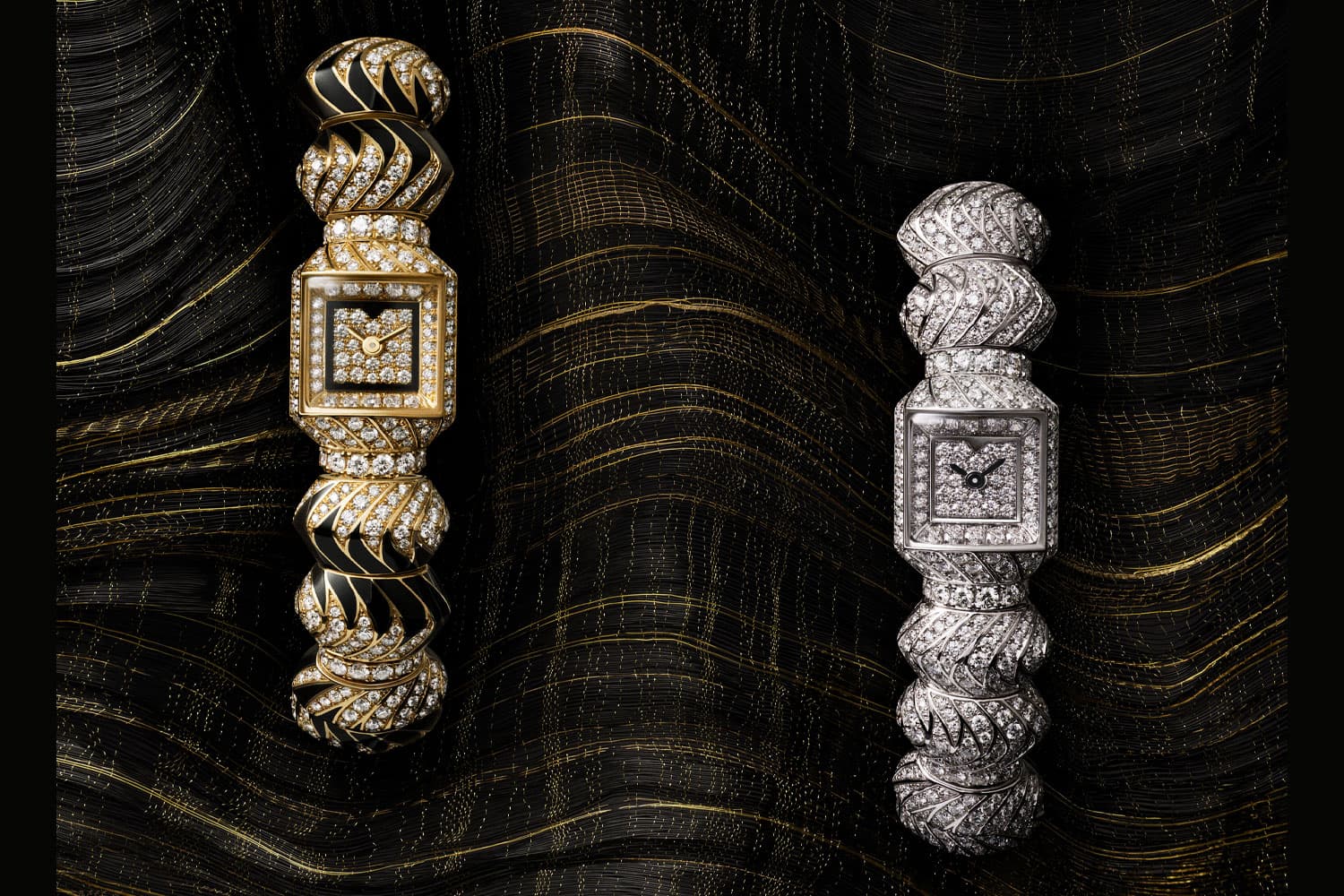
The Myst de Cartier is the most ambitious Métiers d'Art jewellery watch Cartier has presented at Watches & Wonders in years. It is a revival of a sculptural geometric design associated with Jeanne Toussaint, Cartier's celebrated creative director from the 1930s — and the watch's most striking technical feature is also its quietest: there is no traditional clasp. The articulated bracelet expands and contracts via an internal elastic structure, allowing the wearer to slip the watch on and off as a sculptural object rather than fasten it.
Two versions are offered — a yellow-gold execution with hand-applied black lacquer and 634 brilliant-cut diamonds, and a white-gold version pushed to 986 brilliant-cut diamonds without lacquer. Hand gem-setting alone consumes 112 hours per piece, executed at Cartier's Maison des Métiers d'Art in Switzerland.

Design
The Myst de Cartier is built around a 15.4 mm jewellery case integrated into the bracelet architecture rather than presented as a separate watch head. The dial features a geometric pavé framed by a delicate onyx border, with a single triangular hour-marker placed at 12 o'clock — the only concession to time-telling on what is, fundamentally, a sculptural object. Master craftsmen at Cartier's Maison des Métiers d'Art hand-apply the black lacquer dots one by one. The bracelet is built as a bead-like elastic articulation — a series of small linked elements held in tension by an internal spring structure — and slips onto the wrist without any opening mechanism.
Specifications
- Model: Myst de Cartier
- Case: 15.4 mm jewellery case (sculptural, integrated into the bracelet)
- Versions:
- Yellow gold — black lacquer + 634 brilliant-cut diamonds
- White gold — 986 brilliant-cut diamonds (no lacquer)
- Dial: Geometric pavé with onyx border; single triangular hour-marker; hand-applied black lacquer dots
- Bracelet: Articulated elastic-spring construction — no traditional clasp; the watch slips on and off the wrist
- Movement: Quartz (jewellery-watch positioning)
- Production: Maison des Métiers d'Art, Switzerland; 112 hours of gem-setting per watch
- Limited edition: Boutique-exclusive (production volumes not publicly disclosed at time of writing)
- Price: On request
What's Exciting
Cartier rarely commits this level of Métiers d'Art attention to a single new line, and rarer still does the technical centrepiece not involve the movement. The clasp-less elastic-spring bracelet is the engineering story here — it is genuinely difficult to design a piece of jewellery that holds itself securely on a moving wrist without a discrete fastening point and without the wearer feeling the spring tension as an irritant. The bead-like articulation is also a clear callback to the geometric jewellery work that Jeanne Toussaint led at Cartier in the late 1920s and early 1930s. The diamond count differential between the yellow-gold and white-gold executions (634 vs. 986) is also pleasing in its honesty: the white-gold version simply doesn't have black lacquer to displace stones.

History
Jeanne Toussaint (1887–1976) led Cartier's high-jewellery creative direction from 1933 until 1970, and was responsible — among many other things — for the panther motif that became one of the maison's signatures, for the Trinity ring's most famous high-jewellery executions, and for a series of sculptural geometric bracelets that prefigured Op-art jewellery by decades. The Myst de Cartier draws explicitly on a Toussaint sketch from the early 1930s — a moment when Cartier's high jewellery was leaning into hard geometric Art Deco shapes after the lyrical Garland period. The 2026 watch translates that geometric language into a modern jewellery-watch with a contemporary clasp-less mechanism, and positions itself at the heart of Cartier's Métiers d'Art strategy for the year.
Sources
- WatchGuys — New Cartier 2026 Releases: Every Watch, Price & Specs
- Hautetime — All of Cartier's Watches and Wonders 2026 Novelties
- L'Officiel — Cartier's Myst de Cartier Puts Jewelry First at Watches & Wonders 2026
- Insight Luxury — Watches & Wonders 2026: Precious Metals, Diamonds, and a Panther by Cartier