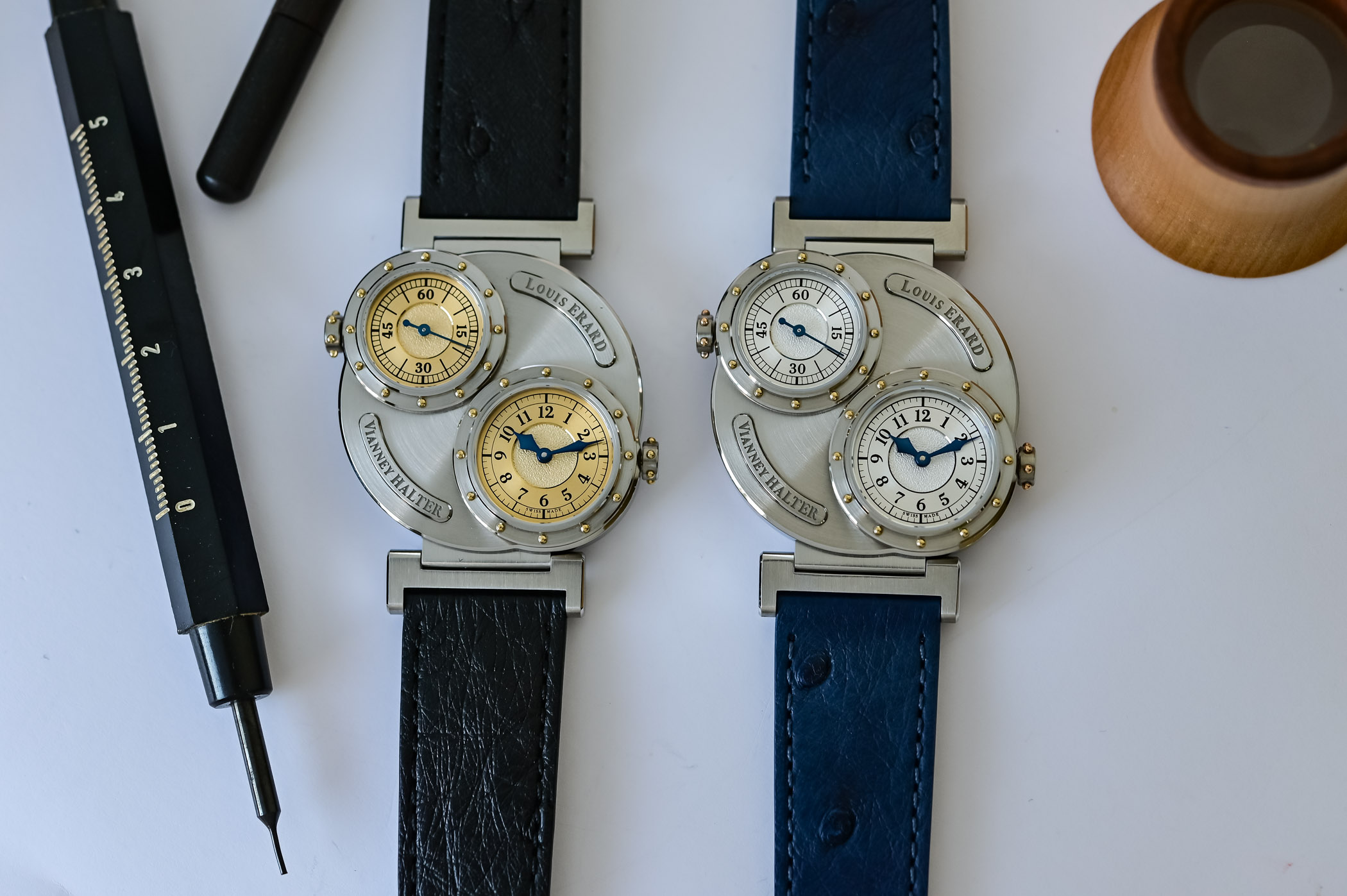
Description
Vianney Halter's Antiqua has been the most quoted watch in avant-garde independent watchmaking since it appeared at Basel in 1998, and for almost thirty years the only way to own that riveted, porthole-faced look was to buy a Halter. The Louis Erard x Vianney Halter Futur Antérieur, announced on 30 October 2026, is the closest anyone has come to selling it at a price a normal collector can reach: CHF 4,950 before tax, in a 38 mm steel case, limited to 178 pieces per dial colour.
This is the third watch in the Louis Erard and Vianney Halter partnership, and the first that is not a regulator. Where the 2020 and 2024 collaborations put Halter's design language onto an existing Louis Erard platform, the Futur Antérieur was drawn from scratch around the idea, with a 67-part case built to carry two raised porthole counters set on a diagonal. The name is the French future-perfect tense, and it is a direct nod to how Halter once described the Antiqua: a relic of the future past.
Two references were released together — 22243AA01.BOA02 with yellow-gold-toned counters on a black ostrich strap, and 22243AA07.BOA05 in a silver tone on blue. A 78-piece set containing both is offered at CHF 9,900 before tax. All three are available now through the Louis Erard online store and its retailers.
Design
The dial is the whole argument. Two porthole sub-dials physically protrude from the case on a diagonal axis, each ringed by a stepped bezel carrying twelve polished rivets plated in pale yellow 1N gold. The lower porthole carries hours and minutes; the upper one carries small seconds alone. Both have grained baseplates and grained centres, recessed and frosted, and both are framed by a wide circular-brushed chapter ring printed in black. Each porthole gets its own sapphire crystal, anti-reflective coated on both faces. The hands are classic Vianney Halter blued steel, on both the time counter and the seconds.
The steel case runs 38 mm across, 44 mm long and 8.85 mm thick, with the finishing broken up deliberately: circular-brushed on top, vertically brushed on the flanks with a polished bevel, and circular-brushed again on the raised counter frames. The case and bezels are chamfered, and the lugs are hinged — which, with the two raised counters, makes the watch wear a little larger than 38 mm suggests. Each crown is a riveted Halter-style crown with six gold-plated rivets, and two bevelled appliqués on opposite flanks read "Louis Erard" and "Vianney Halter". The caseback is solid and engraved "Louis Erard x Vianney Halter 1 of 178". Straps are ostrich leather with a grained calfskin lining, a polished steel pin buckle and ergot bars for tool-free changes: black on the gold reference, blue on the silver one.
Two honest caveats. The porthole surfaces reproduce the Antiqua's appearance but not its hand-finishing technique, which on the original is engraved and then lacquer-filled. And on the silver reference, Monochrome's body text describes the counters as rhodium-plated while its own specification table lists ruthenium, so the exact plating is not settled between the published accounts.
Specifications
- References: 22243AA01.BOA02 (gold-toned counters, black strap); 22243AA07.BOA05 (silver-toned counters, blue strap)
- Case diameter: 38 mm
- Case length (lug to lug): 44 mm
- Case thickness: 8.85 mm
- Case material: stainless steel, 67 parts; circular-brushed top, vertically brushed flanks with polished bevel, chamfered case and bezels, hinged lugs
- Bezels: stepped porthole bezels, each with 12 polished rivets plated in pale yellow 1N gold
- Crystal: two sapphire crystals, anti-reflective coating on both sides
- Caseback: solid steel, engraved "Louis Erard x Vianney Halter 1 of 178"
- Water resistance: 50 m
- Dial: two raised porthole counters on a diagonal axis, grained baseplates and centres, wide circular-brushed chapter ring with black printing; blued-steel Vianney Halter hands
- Movement: two separate Sellita automatic calibres in one case — one driving hours and minutes, the other driving the off-centre small seconds only. Each movement 17.2 mm x 4.8 mm, 25 jewels. Note: Monochrome identifies both as Sellita SW100; SJX Watches lists an SW200 for the time train alongside an SW100 for the seconds. The two published accounts do not agree, and Louis Erard has not been quoted settling it.
- Complications: hours, minutes and off-centre small seconds, each on its own movement and its own porthole
- Frequency: 28,800 vph (4 Hz)
- Winding: automatic (both movements)
- Power reserve: minimum 38 hours (SJX gives a 38-42 hour range)
- Strap: ostrich leather with grained calfskin lining, polished steel pin buckle, ergot quick-change bars
- Limited edition: 178 pieces per reference, plus a 78-piece set containing both
- Price: CHF 4,950 excluding tax per watch; CHF 9,900 excluding tax for the set
- Availability: now, Louis Erard online store and retailers
What's Exciting
Using two complete movements to display three hands is, by any engineering logic, absurd — and it is exactly why this watch works. Halter's Antiqua put each indication behind its own bulging porthole, like a row of diving helmets, and you cannot honestly reproduce that from a single centre-mounted train. Rather than fake the separation with a dial trick, Louis Erard bought the geometry outright: one Sellita for the time, a second Sellita doing nothing but turning a seconds hand. It is the opposite of the industry's usual move of integrating more functions into fewer parts, and it is far more interesting than a thinner module would have been.
The value story is unusually clean. Halter's own watches trade in six figures. This is CHF 4,950 for the shape, the riveted portholes, the blued hands and the hinged, chamfered case, with the honest compromise stated out loud — stamped and plated detailing instead of engraved-and-lacquered, stock Swiss automatics instead of a Halter calibre, a solid caseback because there is nothing worth showing underneath. That is a better trade than most homage watches offer, and it is a genuinely new design rather than, as with the earlier collaborations, an existing model wearing a new dial. If there is a criticism, it is the pair of co-branded nameplates on the case flanks; the watch is recognisable enough without them.
History
Vianney Halter trained as a restorer of antique clocks and watches before showing the Antiqua perpetual calendar as a prototype at Basel in 1998. Three of its four sub-dials bulged out of the case, each framed and riveted like a porthole, and the result became one of the founding objects of modern avant-garde independent watchmaking — the piece most often reached for to explain what "steampunk" means on a wrist. The concept was developed with the American artist Jeff Barnes, and the earliest examples carried the name Halter Barnes.
The Louis Erard side of the story begins in 2020, when CEO Manuel Emch invited Halter to design a watch and the two produced a Régulateur at EUR 3,500 — the first time Halter's hand was available at that money. A second Régulateur followed in 2024, this time borrowing the Antiqua's riveted porthole treatment directly. The Futur Antérieur is the third and, by both outlets' reading, the finale: the first drawn as a new design rather than adapted onto a stock platform, and the closest of the three to the 1998 original. Halter also lent the Antiqua language to Bulgari in 2026 for an Octo Finissimo Dual Time, making this a notable year for a watch that was, for a long time, a cult object known mainly to collectors.