
Description
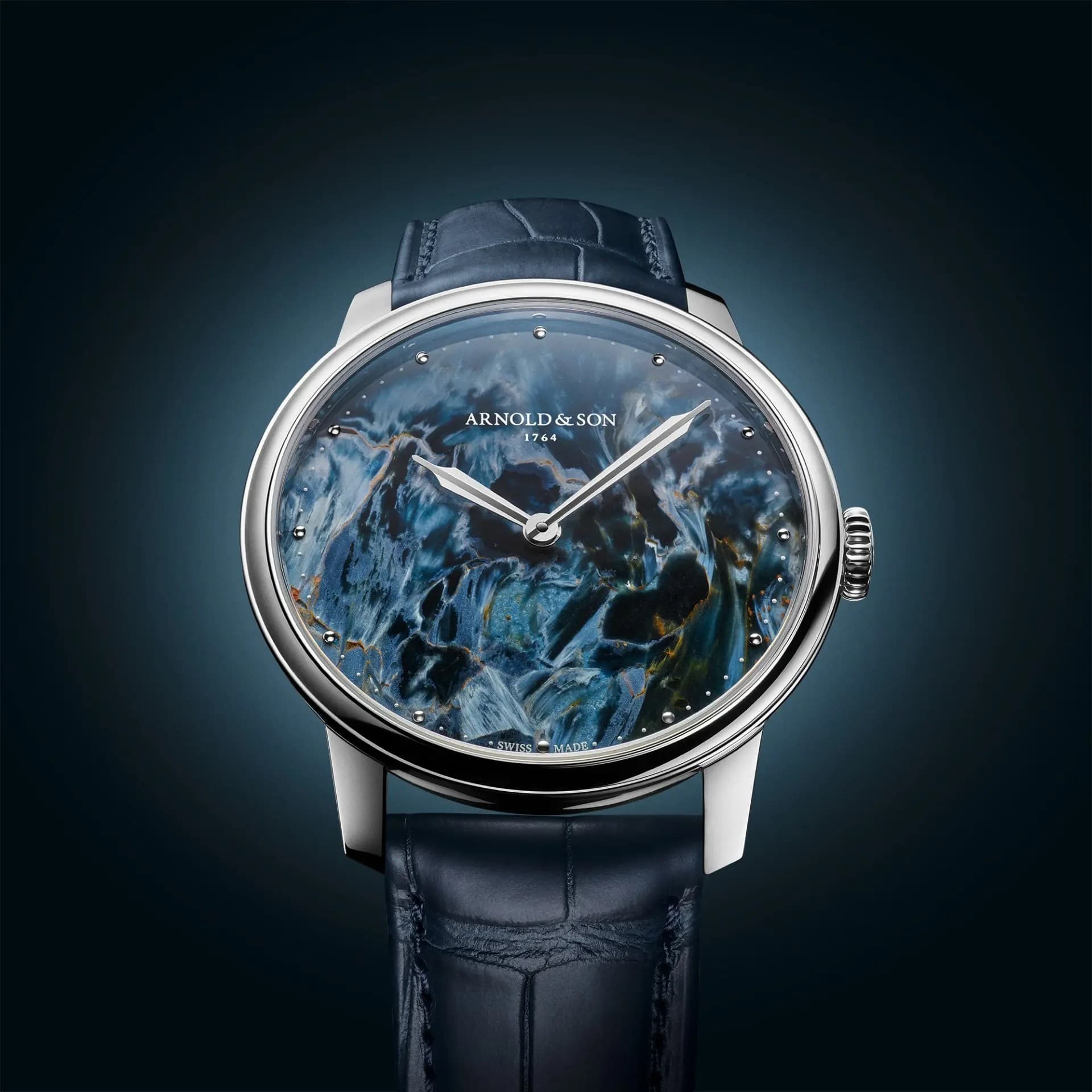
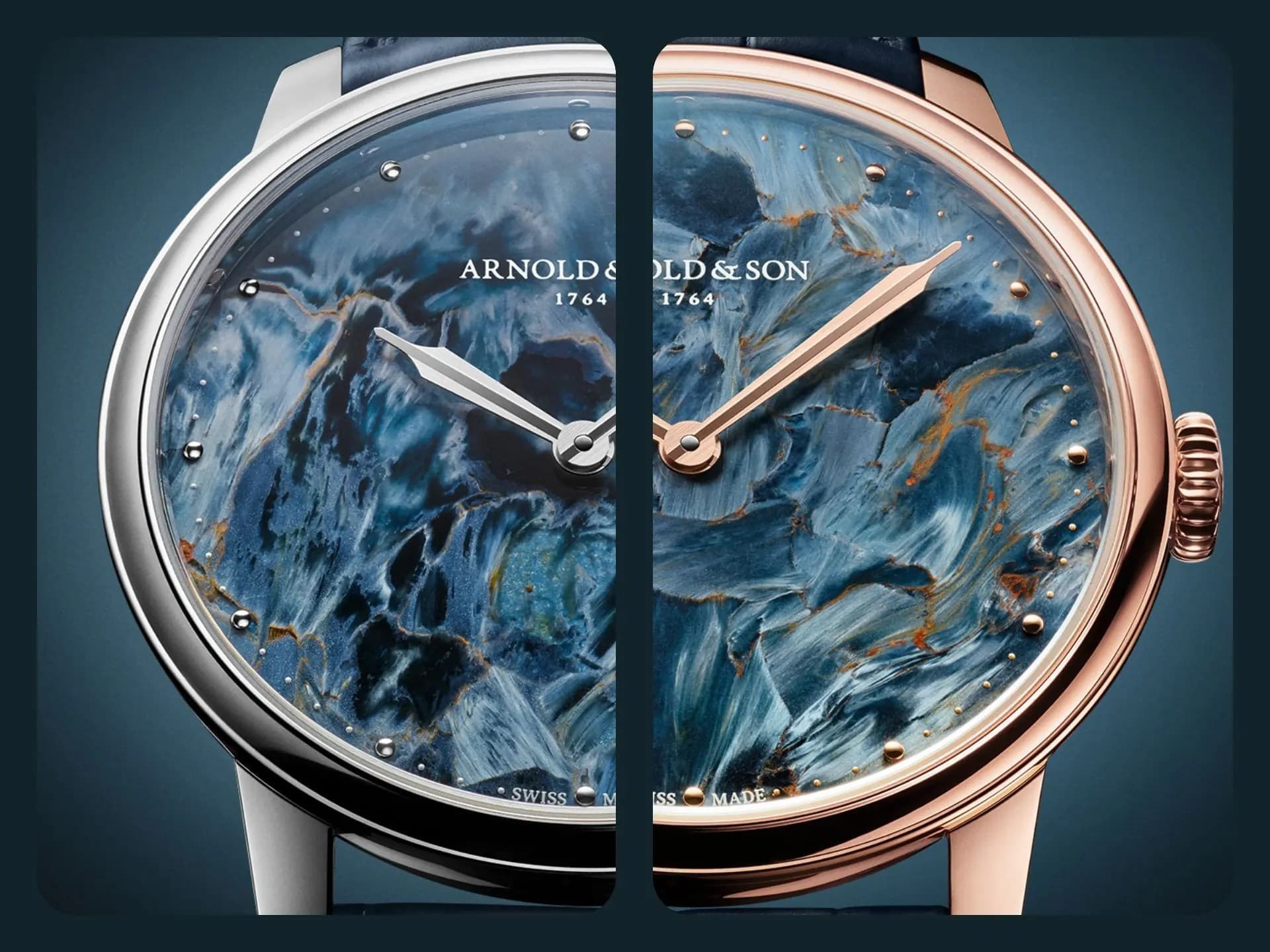
Arnold & Son's HM Pietersite may turn out to be one of the most quietly compelling value-for-money releases of Watches & Wonders 2026. The brand has, for the first time, used Namibian pietersite — the swirling blue / brown / grey "tempest stone" — as a dial material in its HM (His Majesty) ultra-thin reference. Each dial is, by the nature of pietersite's irregular fibrous chatoyance, completely unrepeatable: no two examples will ever look the same, and the storm-sky pattern that gives the stone its nickname is impossible to fake with paint, lacquer, or guilloché.
What lifts the HM Pietersite from "interesting stone-dial dress watch" into "genuine value proposition" is the powertrain underneath. The case is 39.5 mm wide and a remarkable 7.82 mm thin; behind the sapphire caseback sits the in-house manually wound calibre A&S1001 with a 90-hour power reserve, fully hand-finished with chamfered bridges, radiating Côtes de Genève, snail-finished wheels, and blued screws. At CHF 16,200 for the 18-piece steel edition, this is one of the most generous in-house propositions of the entire fair.

Design
The case is round and slim — 39.5 mm × 7.82 mm — with a polished bezel and a domed sapphire crystal. Two metal options are offered: stainless steel (18 pieces) and 18K 5N red gold (8 pieces). The dial itself is a slice of natural Namibian pietersite, polished to reveal the stone's signature "storm" pattern of swirling blue, brown, and grey fibres. Slim applied indices and dauphine hands sit just above the surface so as not to compete with the dial's natural drama, and the seconds track is etched onto a chapter ring at the periphery. The watch is supplied on an ink-blue alligator strap with a matching pin buckle.
Through the sapphire caseback, the calibre A&S1001 is on full display: a rhodium-plated, circular-grained main plate; bridges with chamfered (anglage) edges and radiating Côtes de Genève; snail-finished wheels; and blued screws with polished, chamfered heads. It is the kind of finishing that, in 2026, has migrated almost entirely upmarket — making its presence at this price point a real story.
Specifications
- Reference / Model: HM Pietersite — Steel (LE 18) and Red Gold (LE 8)
- Case: 39.5 mm × 7.82 mm; stainless steel or 18K 5N red gold
- Bezel: Slim polished
- Crystal: Domed sapphire, anti-reflective
- Caseback: Sapphire, anti-reflective
- Dial: Natural Namibian pietersite — each piece unique
- Movement: Calibre A&S1001 — in-house, manually wound
- Finishing: Rhodium-plated main plate with circular graining; chamfered bridges with radiating Côtes de Genève; snail-finished wheels; blued screws with polished chamfered heads
- Frequency: 21,600 vph (3 Hz)
- Power reserve: 90 hours
- Water resistance: 30 m
- Strap: Ink-blue alligator with matching pin buckle
- Limited editions: 18 pieces in steel; 8 pieces in red gold
- Price: CHF 16,200 (steel) / CHF 27,100 (red gold)
What's Exciting
This is one of the genuinely rare watches at W&W 2026 where the price-to-content ratio favours the buyer rather than the brand. An in-house, manually wound, hand-finished calibre with a 90-hour power reserve in a 7.82 mm-thin 39.5 mm case, fitted with a natural unrepeatable stone dial, for under CHF 17,000 in steel — this is the kind of spec sheet that, from a more famous house, would carry a 30K+ premium. The pietersite dial choice is also a piece of editorial taste: most stone dials trend toward malachite, lapis, or aventurine; Namibian pietersite is far less commonly used and rewards close inspection in changing light.


History
John Arnold (1736–1799) was one of the most important figures in 18th-century English horology, credited with inventing the term "chronometer" and producing pocket marine chronometers used by the Royal Navy. The modern Arnold & Son revives that heritage from a base in La Chaux-de-Fonds, Switzerland, with a focus on hand-finished movements, dressy wristwatch proportions, and recurring stone-dial themes. The HM (His Majesty) line is the brand's slim dress reference; previous executions used onyx, lapis, and meteorite. The HM Pietersite is the first to use the swirling Namibian "stone of storms," chosen as a callback to the maritime, weather-dependent context of Arnold's original chronometers — Cornish skies and storm-sea horizons rendered into a natural mineral surface.
Sources
- Watch Collecting Lifestyle — Arnold & Son HM Pietersite, Where the Dial is the Complication
- Revolution Watch — Arnold & Son at W&W 2026: HM Pietersite & Ultrathin Tourbillon Onyx
- Hourstriker — Arnold & Son HM Pietersite Mastering The Stone Dial
- Oracle of Time — Arnold & Son Launches the HM Pietersite
- Arnold & Son — Official Product Page (HM Red Gold Pietersite)