Description
Tudor has revived the Northflag, a decade after the original North Flag arrived in 2015 as the watch that carried the brand's very first in-house calibre. The 2026 edition, reference M9140G1A0U-0001, keeps the integrated-bracelet explorer silhouette but swaps the old power-reserve indicator for something far more useful on the road: a flyer-style GMT with an independently jumping local hour hand.
It is a 40 mm steel watch with 100 m of water resistance, a Master Chronometer-certified movement, and a T-fit clasp — in other words, a genuine go-anywhere-do-anything proposition rather than a design exercise. At CHF 4,500 (roughly €5,050–5,100 and USD 5,525 depending on market), it sits squarely in Tudor's upper-middle ground, above the Black Bay 58 and below the ceramic chronographs.
The catch, and it is a real one, is distribution: the Northflag is sold exclusively through Tudor boutiques worldwide, not through the wider authorised-dealer network.
Design
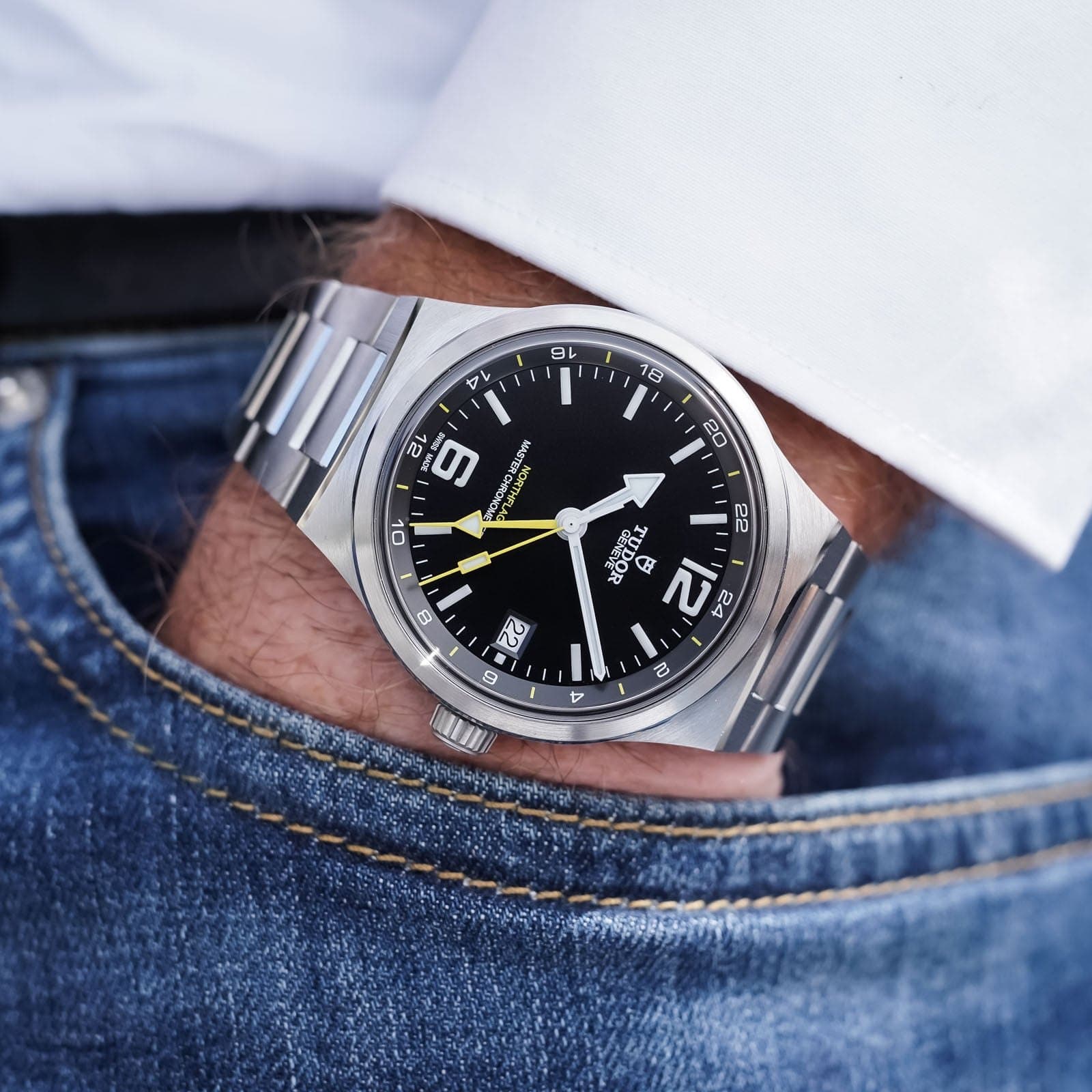
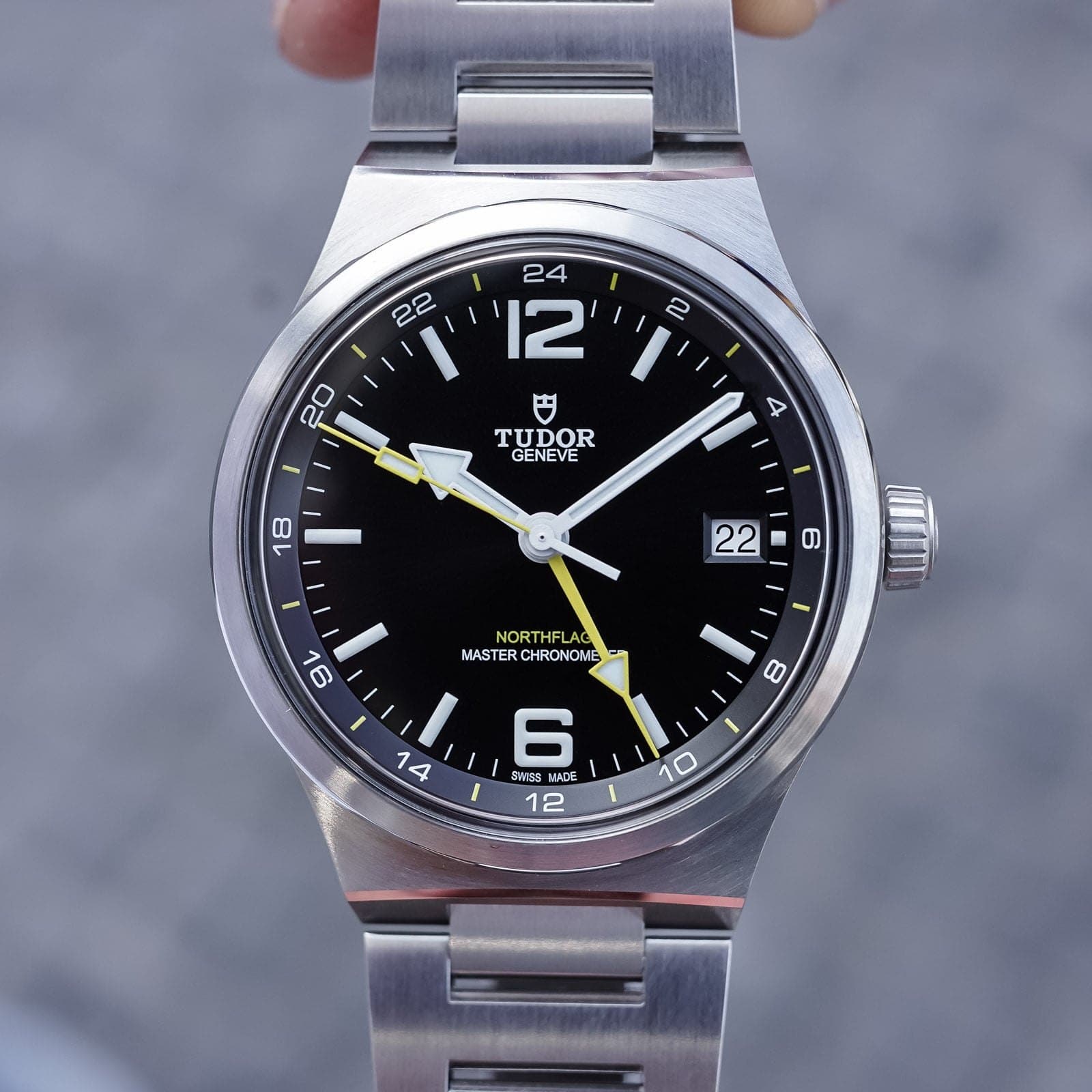
The new Northflag reads more like the 2015 model than the 1973 Ranger II both are said to descend from, but the Ranger II cues are there if you look: the hour markers at 12 and 6 o'clock are noticeably more prominent than the rest, and the handset echoes the shape used on the 1973 reference 9111/0. The steel case mixes satin-brushed flanks with polished chamfers, and the fixed steel bezel keeps the profile clean. A domed sapphire crystal covers the dial; a second domed sapphire sits in the screw-in caseback to show off the movement.
The dial is black with a sunray brushed finish, carrying large ceramic luminous hour markers, a 24-hour rehaut for the second time zone, and a date window at 3 o'clock. Four central hands do the work — hours, minutes, seconds and a 24-hour GMT hand — with the seconds and GMT hands finished in a bright yellow that deliberately recalls the accents of the 2015 Northflag. The integrated H-link bracelet carries the same brushed-and-polished treatment as the case and closes on Tudor's T-fit clasp, which offers five tool-free positions across an 8 mm range.
Specifications
- Reference: M9140G1A0U-0001
- Case diameter: 40 mm
- Case thickness: 12.7 mm
- Lug-to-lug: 48.8 mm
- Case material: stainless steel, polished and satin-brushed surfaces
- Bezel: fixed stainless steel
- Crystal: domed sapphire
- Caseback: screw-in steel with domed sapphire display window
- Crown: screw-down
- Water resistance: 100 m (10 bar)
- Dial: black with sunray brushed finish, ceramic luminous hour markers, 24-hour rehaut, date at 3 o'clock, yellow central seconds and GMT hands
- Movement: Tudor calibre MT5652-U, manufacture movement produced with Tudor's movement partner Kenissi, automatic with manual winding and hacking seconds
- Complications: flyer-style GMT (24-hour hand), date
- Escapement: variable-inertia balance with silicon balance spring, 32 jewels
- Frequency: 28,800 vph (4 Hz)
- Power reserve: 65 hours
- Certification: COSC chronometer and METAS Master Chronometer (0/+5 seconds per day, magnetic resistance to 15,000 gauss)
- Bracelet: integrated stainless steel H-link with T-fit clasp, five positions across 8 mm
- Limited edition: no — permanent collection
- Price: CHF 4,500 / approx. €5,050–5,100 / USD 5,525 (market dependent)
- Warranty: five years
- Availability: Tudor boutiques only, worldwide
What's Exciting
The most interesting thing Tudor did here was subtract. The 2015 North Flag's power-reserve disc at 9 o'clock was the detail most people argued about, and removing it leaves a dial that finally looks balanced rather than busy. What replaces it is a complication people actually use. A flyer GMT at this price, with METAS certification and a silicon hairspring, is a hard combination to find — the Black Bay GMT is the obvious in-house comparison, and this one is thinner at 12.7 mm and lighter on the wrist thanks to the integrated bracelet.
The value argument holds up too. A 65-hour, chronometer-and-Master-Chronometer-certified manufacture GMT with a five-year warranty for CHF 4,500 is the kind of specification sheet that would have carried a five-figure price a decade ago. The boutique-only distribution is the sting: it makes the watch harder to see in the metal before committing, and in markets without a Tudor boutique it effectively means buying blind.
History
The original North Flag landed in early 2015, just ahead of Baselworld, launched at a theatrical reveal involving Land Rover Defenders and a tipi in a Swiss forest. Its real significance was mechanical, not theatrical: it introduced calibre MT5621, Tudor's first in-house-developed movement, at a moment when almost nobody expected the brand to break from the ébauche-based tradition Hans Wilsdorf had set for it. Tudor framed the model as a descendant of the 1973 Ranger II, a tool watch built for polar and expedition use.
The North Flag was quietly retired, and its reputation improved in absentia — a familiar pattern for watches that are ahead of taste rather than behind it. Tudor teased the return on Instagram before the launch, and the 2026 Northflag now closes the loop: same expedition brief, same integrated-bracelet format, but with the in-house movement programme eleven years further along and a complication that suits the way people actually travel.