Description
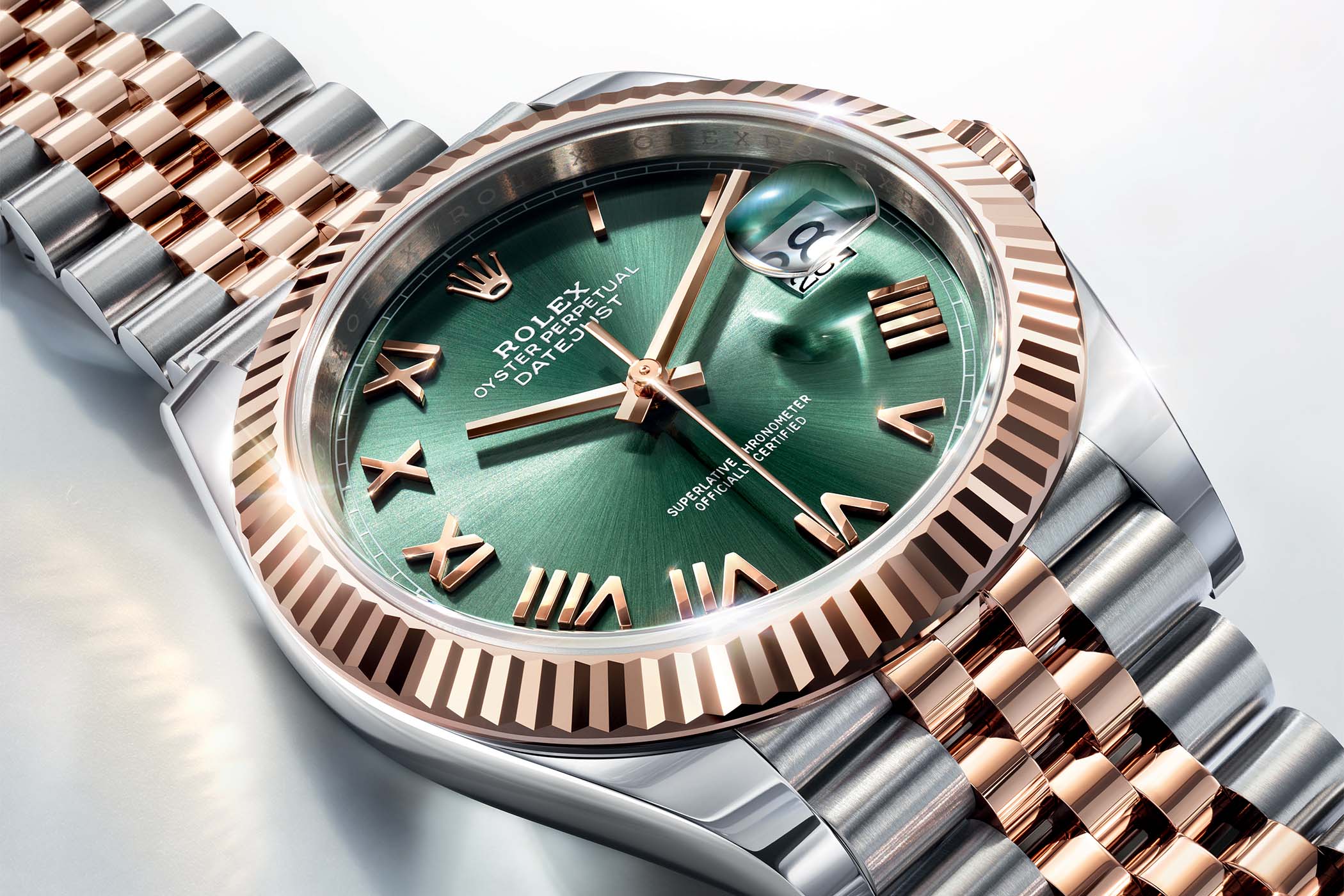
The 2026 Rolex Datejust update is a perfect study in how the crown actually launches its real novelties. There was no W&W 2026 press release. There was no centre-stage announcement. There was no countdown video. And yet, when the trade press began comparing 2026 production references to their 2025 predecessors, one quiet but completely consistent change emerged across every Datejust 41 and Datejust 36 reference fitted with applied Roman numerals: the numerals themselves have been redesigned.
Where the Datejust's Roman numeral indices had been single-piece, faintly serifed elements for years, the 2026-onward references are sans-serif and multi-element. The IIII is built from four discrete batons. The VIII from four discrete elements. The new construction is sharper, more architectural, and very visibly closer to the applied numerals on the Day-Date — bringing the Datejust visually in line with its bigger sister for the first time in years.
This redesign is rolling across a long list of 2026 references in steel, Rolesor (steel/yellow gold and steel/Everose), and full Everose, and on a wide range of dial colours including mint green, slate, chocolate, rosé, bright black, white and the much-discussed green ombré. It is the most meaningful Datejust dial refresh in years — and the kind of update that almost nobody outside the watch trade press will notice.
Design
The case formats remain unchanged: the Datejust 41 retains its 41 mm Oyster case with smooth or fluted bezel and choice of Oyster or Jubilee bracelet, and the Datejust 36 keeps its classic 36 mm proportions. The redesign happens on the dial. Each applied Roman numeral is now sans-serif, with thinner verticals and a more geometric profile. Crucially, each numeral is built from multiple discrete elements: the IIII at 4 o'clock is composed of four individual batons, the VIII at 8 o'clock from four discrete component elements. Where 2025-and-earlier Datejust Roman numerals were single applied castings, the 2026 references are deliberate, multi-piece architectures.
The visible result is a dial that looks crisper at arm's length and that, in person, has more depth thanks to the gaps between the discrete element strokes. The new construction also brings the Datejust visually closer to the Day-Date's applied numerals — a deliberate move that makes the two model families feel, for the first time in a long time, like genuine siblings rather than distant cousins.
The 2026 Datejust dial palette is itself unusually broad. The headline colours are mint green, green ombré (gradient green, exclusive to Steel + Everose Rolesor and full Everose configurations), chocolate, rosé, slate, bright black and white. All seven dial colours roll out across the new Roman numeral architecture.
Specifications
- Affected references (non-exhaustive): Datejust 41 in steel (e.g. 126300), Steel + Yellow Rolesor (126303), Steel + Everose Rolesor (126331), full Everose (126335), and equivalent white-gold and yellow-gold references; Datejust 36 equivalents (126200, 126233, 126234, etc.)
- Case sizes: 41 mm (Datejust 41) and 36 mm (Datejust 36)
- Case materials: Oystersteel; Steel + Yellow Rolesor; Steel + Everose Rolesor; full Everose; full White Gold; full Yellow Gold (depending on reference)
- Bezel: Smooth, fluted, or diamond-set, depending on reference
- Crystal: Sapphire with date Cyclops at 3 o'clock
- Dial: Mint green, slate, chocolate, rosé, bright black, white, or green ombré, with redesigned multi-element sans-serif applied Roman numerals; date aperture at 3 o'clock
- Movement: Calibre 3235 — automatic, self-winding; Superlative Chronometer (-2/+2 sec/day); Chronergy escapement; Parachrom hairspring; ~70 h power reserve
- Functions: Hours, minutes, central seconds, date
- Bracelet: Oyster or Jubilee, depending on reference
- Water resistance: 100 m
- Availability: Rolling into authorised dealers throughout May–June 2026
- Pricing: Datejust 41 in steel from approximately USD 8,400; full-gold references up to approximately USD 35,500 depending on configuration
What's Exciting
Three things make this redesign more than catalogue housekeeping. First, it is a signature change. Once you know what to look for — the multi-element IIII, the multi-element VIII, the sans-serif geometry — you can identify a 2026-onward Datejust at a glance. That is a meaningful piece of identity work for a model family that has not visually evolved much in the last decade. Second, it brings the Datejust into clear visual lineage with the Day-Date, which reinforces the family hierarchy at the centre of the Rolex catalogue (and incidentally makes a 2026 Datejust feel slightly more like a President's understated cousin).
Third, the redesign comes paired with one of the broadest dial-colour expansions the Datejust has had in years. The green ombré dial in particular is rapidly emerging as the cult collector pick of the 2026 line — especially in Steel + Everose Rolesor — and the new mint green dial is the freshest non-obvious colour Rolex has put on a Datejust in a while. Combined with the new Roman numeral construction, the 2026 Datejust quietly becomes the most distinctive Datejust generation since the launch of the calibre 3235 in 2015.
History
The Rolex Datejust is the longest-running automatic chronometer wristwatch with a date in production. Introduced in 1945 to mark Rolex's 40th anniversary, the Datejust pioneered the instantaneous date change at midnight and has remained the brand's most universally recognised classic ever since. The 41 mm Datejust 41 was introduced in 2016, replacing the Datejust II; the 36 mm Datejust 36 retains the closest modern proportions to the original 1945 design.
The applied Roman numeral dial has been a Datejust signature for decades, but the construction of those numerals has stayed broadly consistent: a single-piece, lightly-serifed casting, polished and applied to the dial. The 2026 redesign is therefore the most meaningful evolution of the Datejust's most iconic dial style in a generation. It comes in the year following the centenary of the Rolex Oyster case (1926–2026), which Rolex marked with the Oyster Perpetual 41 "100 Years" reference at W&W 2026. The Datejust dial refresh is the second, much quieter chapter of that centenary refresh — one that says as much about Rolex's product strategy as the louder novelties did.
Sources
- Monochrome Watches — News: Rolex Quietly Updates the Datejust 41 and 36 in 2026 with new Roman Numeral Dials
- Teddy Baldassarre — Rolex Quietly Updates The Datejust With New Roman Numeral Dial
- Gear Patrol — Rolex's Most Boring New Watch Is Also Quietly One of Its Best (Datejust Green Ombré)
- Luxury Bazaar — All the 2026 Rolex Releases