Description
Raymond Weil has done something it has never done in nearly five decades of watchmaking: it has built a watch around an integrated bracelet. Unveiled on 8 June 2026, the new A.R.T. collection — the initials stand for “Art, Refinement and Timekeeping,” though the name is not strictly an acronym — marks the independent, family-owned Geneva house’s entry into the most competitive corner of the modern market: the luxury sports watch with a case-and-bracelet that flow as one. It arrives in a year that matters, Raymond Weil’s 50th anniversary.
The collection centres on the automatic A.R.T. Date 38mm (the “ART 1000” series), with smaller 30mm quartz references forming the “ART 1250” line, several of them diamond-set. This is not a watch chasing horological fireworks; it is a study in proportion, finishing and accessible pricing — a sub-CHF-2,000 Swiss automatic aimed at the buyer who wants the integrated-bracelet look done with genuine restraint rather than borrowed swagger.
Design
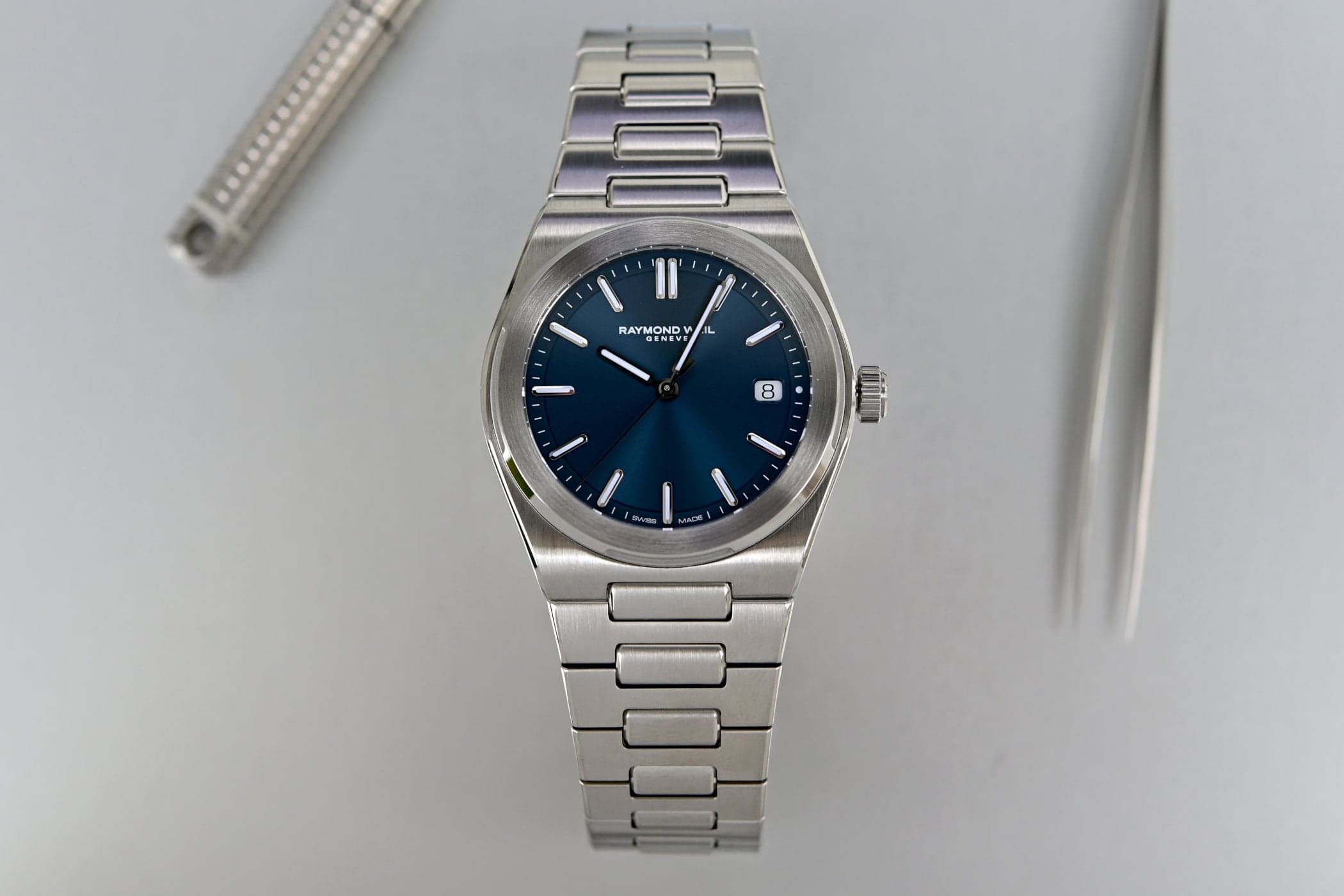
The newly developed stainless-steel case measures 38mm across and roughly 9.95mm thick, slim enough to read as a versatile daily wearer rather than a hard-edged sports tool. Rather than the angular geometry the genre usually leans on, the A.R.T. relies on flowing transitions, polished bevels and curved edges, with satin-brushed surfaces broken up by polished accents. The sculpted bezel hides four small recessed indents visible only from the side — a quiet trick that breaks up the case wall and lets the lines run uninterrupted into the bracelet. A fluted, RW-signed crown sits at 3 o’clock, the AR-coated sapphire crystal is flat, and the solid caseback is left engravable.
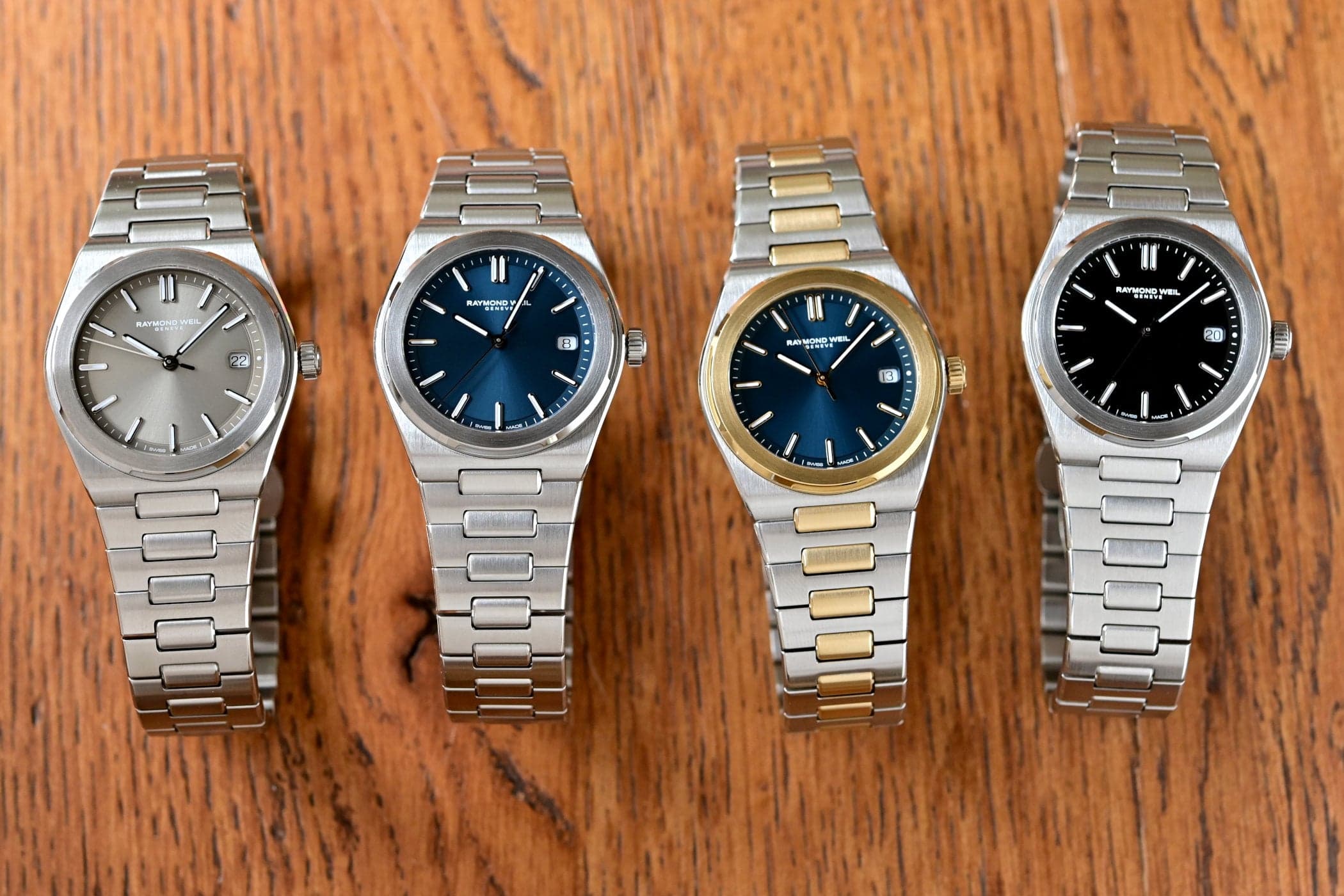
The dial is multi-level: a sunray-brushed centre, a finely azuré outer minute track, and a recessed groove separating the two. Applied indices — doubled at 12 o’clock — and faceted hands are filled with green Super-LumiNova, the hour markers carrying a central divot reminiscent of how Audemars Piguet modernised the Royal Oak’s dial furniture. A framed date sits at 3 o’clock. The integrated H-link bracelet, with polished bevels and chamfered intermediate links, tapers to a folding deployant clasp and follows the wrist closely. Launch dials are graphite/black, metallic blue and silver/sage-grey, with two two-tone versions adding rose-gold-coloured PVD on the bezel, crown and centre links.
Specifications
- References (38mm automatic, five at launch): 1000-ST-20001 (steel, black/graphite); 1000-ST-50001 (steel, metallic blue); 1000-ST-52001 (steel, silver/sage-grey); 1000-STP-20001 (two-tone, black); 1000-STP-50001 (two-tone, blue)
- Case diameter: 38mm
- Thickness: approx. 9.95mm
- Case material: stainless steel; two-tone versions add rose-gold-coloured PVD accents
- Bezel: sculpted, with four recessed side indents
- Crystal: flat sapphire with anti-reflective coating
- Caseback: solid stainless steel (engravable)
- Water resistance: 100m
- Dial: sunray-brushed centre, azuré minute track, applied indices (double at 12), faceted hands, green Super-LumiNova; date at 3 o’clock
- Movement: Sellita SW200-based automatic (ETA 2824-2 architecture) — not in-house
- Frequency: 28,800 vph (4 Hz)
- Winding: automatic
- Power reserve: approx. 41 hours
- Functions: hours, minutes, central seconds, date
- Bracelet: integrated stainless-steel H-link with folding deployant clasp
- Price: CHF 1,795 / EUR 1,995 / USD 1,995 (steel); CHF 1,895 / EUR 2,095 / USD 2,095 (two-tone)
- Availability: permanent collection (not limited)
What's Exciting
The integrated-bracelet sports watch is the single most crowded design conversation in watchmaking right now, and most newcomers either ape the Royal Oak and Nautilus too literally or fumble the proportions. The A.R.T. is the rare entrant that gets the geometry right at a price that undercuts almost every Swiss rival: the bracelet is the correct thickness relative to the case, the hands and indices are sized properly to the dial, and the lines actually resolve where they should. aBlogtoWatch went as far as calling it “one of the nicest Gerald Genta-style integrated bracelet watches since, perhaps, Mr. Genta himself.” For a value-for-money story — this blog’s favourite beat — a sub-CHF-2,000 steel integrated automatic with this level of finishing punches well above its weight.
It is fair to flag the trade-off: this is a Sellita SW200, not an in-house movement, and the caseback is solid. But at this price that is the honest engineering choice, and it lets Raymond Weil spend where it shows — on the case, dial and bracelet. As a 50th-anniversary-year statement from an independent Geneva house, the A.R.T. is a confident, well-judged debut rather than a cynical bandwagon move.
History
Raymond Weil was founded in Geneva in 1976 by the man whose name it carries, and it remains one of the last independent, family-run Swiss watch houses — today led by his grandson Elie Bernheim. Across five decades the brand built its reputation on accessible mechanical watchmaking and on a deep association with music, from collection names (Maestro, Toccata, Millesime, Freelancer) to long-running cultural partnerships. Notably, in all that time it had never produced an integrated-bracelet design.
The A.R.T. changes that, and the timing is deliberate: 2026 is Raymond Weil’s 50th anniversary, and the collection is positioned as a strategic milestone — a new design language and a new category for the house, conceived as something Gerald Genta might have drawn in the 1970s but reinterpreted for collectors fifty years on. Coming alongside the brand’s anniversary Toccata Heritage capsule, it signals a Raymond Weil willing to plant a flag in the contemporary sports-luxury arena while keeping its founding promise of value intact.
Sources
- Monochrome Watches — First Look: The New Raymond Weil A.R.T. (8 June 2026)
- aBlogtoWatch — Raymond Weil ART Watches Hands-On Debut (8 June 2026)
- Time+Tide — Raymond Weil joins the integrated-bracelet race with the A.R.T. collection
- HODINKEE — Introducing: The Raymond Weil A.R.T. Collection (Live Pics)