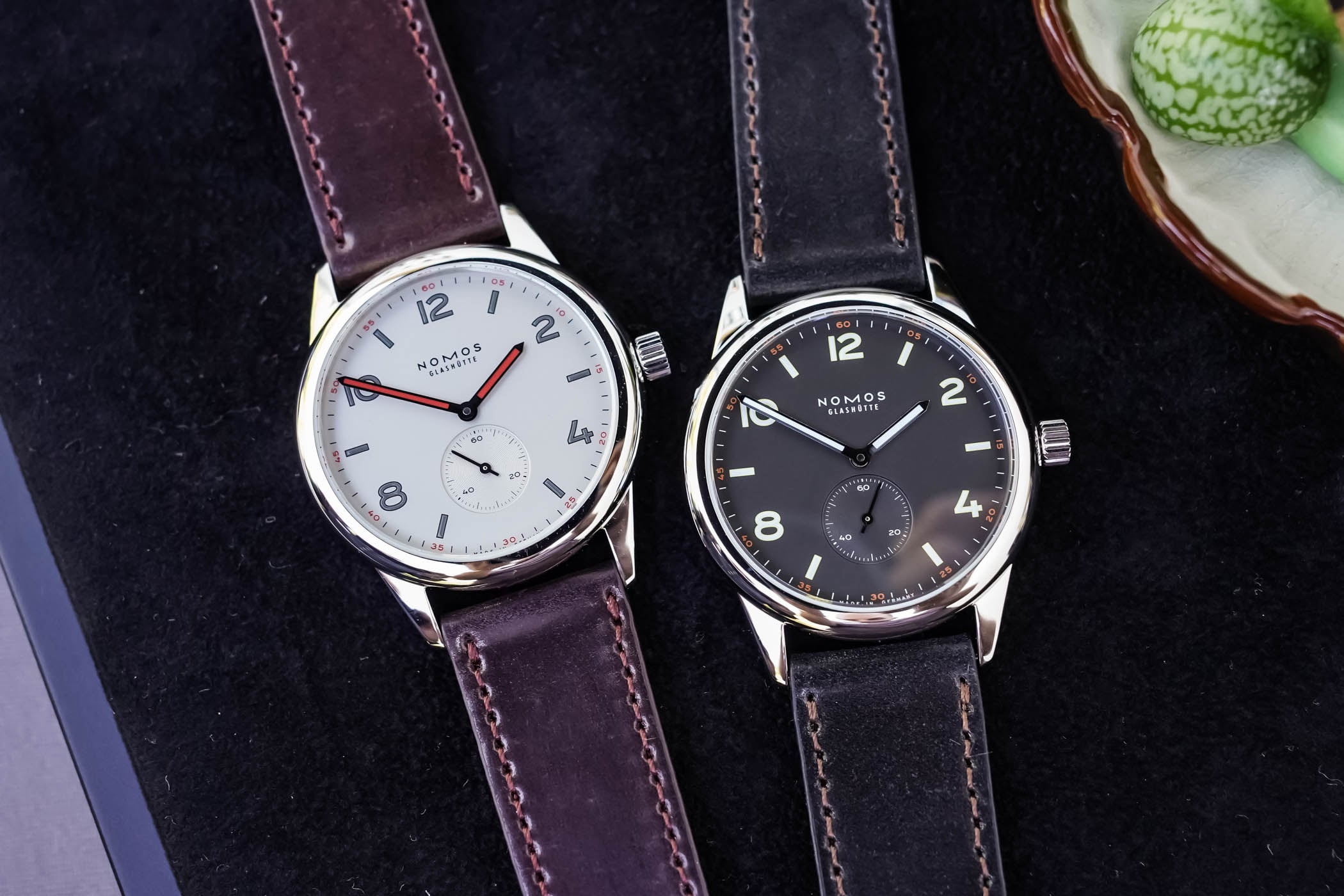
Description
The Club is the watch that made Nomos make sense to people who had never heard of Glashütte: cheap by German-manufacture standards, hand-wound, properly finished, and sized like a 1960s field watch. The problem was that it was sized like a 1960s field watch. Nomos has finally addressed it, and the new Club 38 (reference 769) and Club 38 ruthenium (reference 770) take the hand-wound Club up to 38.5 mm while leaving everything that mattered alone.
These are not limited editions and they are not a seasonal colour exercise. Both references join the permanent collection, available now, with the silver-white dial starting at EUR 1,520 and the ruthenium at EUR 1,560 according to Monochrome Watches. Nomos's own store lists the ruthenium at USD 2,070.
At that money you are getting a German-made, in-house hand-wound movement with the brand's own escapement, 100 metres of water resistance, and a case 8.4 mm thick. There is very little else on the market that does all four at once.
Design
The Club's design language survives the size increase intact: a polished stainless steel case with a thick, flat bezel, broad sword-shaped hands, and the doubled numeral-and-index track that gives the Club its slightly technical, slightly playful face. Super-LumiNova on the hands and markers keeps it a legitimate everyday watch rather than a dress piece. The crystal is domed sapphire, which suits the flat bezel and the 46.7 mm lug-to-lug far better than a flat one would.
The two dials pull the model in different directions. Reference 769 uses a silver-plated white dial — the classic, restrained Club look, paired with brown Horween Genuine Shell Cordovan and red stitching. Reference 770 goes dark grey ruthenium, which reads sportier and colder, on black leather. Both take 20 mm straps on a steel pin buckle. The caseback is screwed steel as standard, with a sapphire display back available as an option for EUR 220 extra, which on a movement finished like this one is money well spent.
Specifications
- References: 769 (silver-white dial); 770 / 770.GB (ruthenium dial)
- Case diameter: 38.5 mm
- Case thickness: 8.4 mm with steel caseback; 8.5 mm with sapphire caseback
- Lug-to-lug: 46.7 mm
- Lug width: 20 mm
- Case material: polished stainless steel
- Bezel: thick, flat steel
- Crystal: domed sapphire
- Caseback: screwed stainless steel, or optional sapphire crystal (EUR 220 extra)
- Water resistance: 100 m (10 atm)
- Dial: silver-plated white (ref. 769) or ruthenium grey (ref. 770), with Super-LumiNova
- Movement: Nomos calibre DUW 4001, in-house, hand-wound
- Escapement: Nomos swing system
- Complications: hours, minutes, small seconds with stop-seconds
- Frequency: 21,600 vph (3 Hz)
- Power reserve: 53 hours
- Jewels: 17
- Regulation: adjusted in six positions
- Strap: Horween Genuine Shell Cordovan (brown with red stitching on ref. 769; black on ref. 770), steel pin buckle
- Limited edition: no — permanent collection
- Price: from EUR 1,520 (ref. 769) and EUR 1,560 (ref. 770) per Monochrome Watches; USD 2,070 for the ruthenium per Nomos
- Availability: available now
What's Exciting
The value argument here is close to unanswerable. The DUW 4001 is not a dressed-up ETA or a Sellita with a signed rotor — it is Nomos's own hand-wound calibre, running the brand's own swing system escapement rather than a bought-in one, regulated in six positions, and visible through an optional sapphire back. Reaching an in-house escapement at EUR 1,520 is something no Swiss brand manages, and most do not attempt.
What makes this release matter more than a dial refresh is that it removes the only real objection to the Club. The 36 mm version was lovely and too small for a lot of wrists; the 38.5 mm version keeps 8.4 mm of thickness and a 46.7 mm lug-to-lug, so it has grown in diameter without becoming a slab. Adding 100 metres of water resistance to a hand-wound watch this thin is the quieter achievement — it makes the Club 38 a single-watch answer in a way the Tangente, for all its beauty, has never been.
History
Nomos Glashütte was founded in 1990, within months of German reunification, in the Saxon town that had been the centre of German watchmaking since Ferdinand Adolph Lange set up there in 1845. The Club arrived in 2007 as the deliberately informal counterpart to the Bauhaus-derived Tangente: thicker bezel, luminous hands, a doubled numeral track, and a brief to be worn rather than admired. It became the brand's entry point and, through the Club Campus, the watch most often bought as a first mechanical.
The decisive step came later, when Nomos replaced its bought-in escapements with the in-house swing system in 2014 and then built a family of its own calibres around it — the DUW series, of which the hand-wound DUW 4001 in the Club 38 is a member. The 38.5 mm case is the collection's answer to nearly two decades of the same request from its own customers.