Description
Moritz Grossmann is one of those Glashütte names whose modern manufacture tends to fly quietly under the radar of Patek-and-Lange-focused collectors — and yet, when the brand decides to mark its founder's 200th birthday, it does so with a watch that touches one of the rarest hand-finishing traditions in German watchmaking. The 2026 Tefnut Silver-Plated by Friction is the result: a pair of 39 mm × 8.5 mm dress watches, one in white gold and (for the very first time on the Tefnut) one in yellow gold, with dials finished using a 19th-century artisanal technique that almost no other modern house executes by hand.
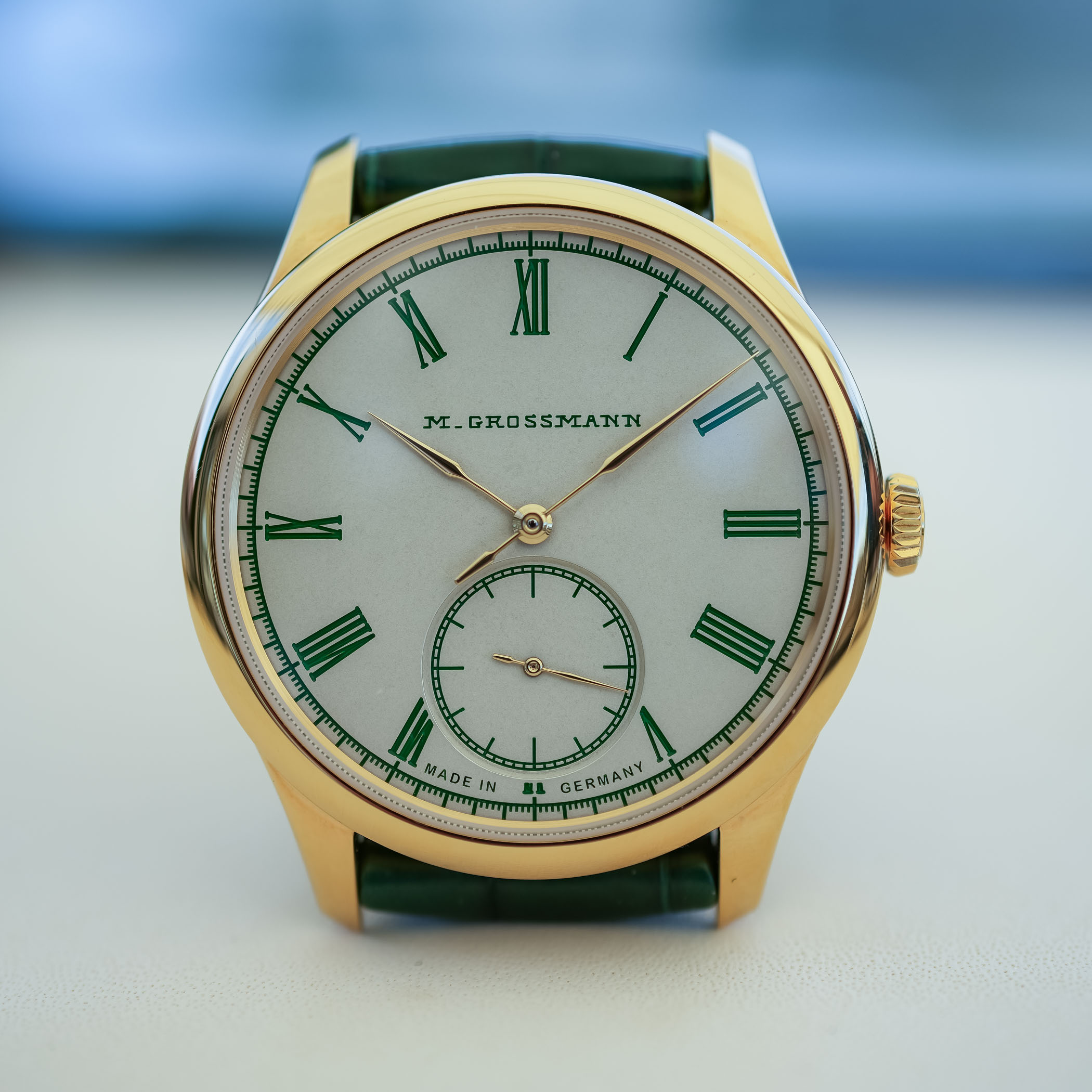
This is the second time the manufacture has applied the silver-by-friction process to the Tefnut, but the 2026 edition adds two new wrinkles. First, yellow gold — a Tefnut first — in addition to white gold. Second, a quiet, well-judged use of green as the anniversary signature colour: the Arabic numerals, the minute and seconds tracks, and the historical 1875 "M. Grossmann" logo are all rendered in the same fresh tone, a subtle nod to the colour codes of the Glashütte trade school where Moritz Grossmann himself taught.
Limited to 12 pieces per metal (24 total) and priced at EUR 52,500 (white gold) and EUR 54,300 (yellow gold), the 200th-Anniversary Tefnut Silver-Plated by Friction is the kind of release that proves there is still meaningful headroom in the dress-watch category — if the manufacture is willing to do the work by hand.
Design
The case maintains the Tefnut's defining proportions: 39 mm in diameter, 8.5 mm thick, identical across both gold variants. The dial is a mirror-flat, fine-grained silver surface produced by a 19th-century technique called silver-plating by friction. The process is performed entirely by hand: a paste of silver powder, salt and cream of tartar is applied to the dial blank, then carefully brushed and polished with successive cloths until a soft, velvety silver grain emerges. The result has a depth and a texture that an electroplated dial simply cannot replicate — in oblique light, the grain becomes a directional sheen that travels with the wrist.
The anniversary detailing is unusually restrained. Rather than commemorative engravings or coloured caseback medallions, Moritz Grossmann uses a single colour, green, applied with discipline. The Arabic numerals at every hour, the minute track, the seconds track at 6 o'clock, and the heritage 1875 "M. Grossmann" logo are all printed in the same fresh, slightly desaturated green. The blued steel hands — the brand's signature flame-blued steel — sit cleanly above the silver dial. The Tefnut's hallmark pusher-set, time-zero seconds reset remains, allowing the wearer to set the seconds to zero with a dedicated pusher rather than by pulling the crown.
Specifications
- Reference: Moritz Grossmann Tefnut Silver-Plated by Friction (200th Anniversary Edition) — white gold & yellow gold
- Case material: 18k white gold or 18k yellow gold
- Case size: 39 mm diameter × 8.5 mm thickness (identical across metals)
- Crystal: Sapphire (front and back)
- Dial: Hand silver-plated by friction (silver powder, salt & cream of tartar paste, hand-brushed and polished); green Arabic numerals, green tracks, green historical 1875 "M. Grossmann" logo
- Hands: Flame-blued steel
- Movement: In-house Moritz Grossmann hand-wound calibre with the brand's signature pusher-set time-zero seconds reset
- Functions: Hours, minutes, small seconds at 6 o'clock with seconds-zero reset
- Limited edition: 12 pieces per metal (24 total)
- Availability: From April 2026
- Price: EUR 52,500 (white gold) / EUR 54,300 (yellow gold) (excl. taxes)
What's Exciting
Three things make this release more than a routine anniversary footnote. First, the silver-plating-by-friction technique is the headline. It is one of the very rarest dial-finishing traditions in Glashütte and almost nobody outside Moritz Grossmann executes it on series wristwatches. The dial cannot be photographed faithfully — it has to be tilted under the light to see what the hand-brushed silver grain actually does. That is genuinely scarce craft.
Second, yellow gold is a Tefnut first. In a year where the wider industry tilts toward sportier configurations, Moritz Grossmann answers with two extremely classical dress watches in 39 mm × 8.5 mm proportions, including a yellow-gold execution that is — rationally — the perfect colour partner for a hand-silvered dial. Third, the green anniversary tone is a quiet historical reference rather than a marketing flourish: it nods to the Glashütte trade-school colours where Moritz Grossmann himself taught in the 19th century. Combined with the 12-pieces-per-metal cap and a price firmly inside the “serious independent dress watch” bracket, this is one of the most carefully thought-through anniversary releases of the year.
History
Moritz Grossmann was born in Dresden on 27 March 1826 — exactly 200 years before this anniversary release. He went on to become one of the four founding figures behind Glashütte's emergence as a watchmaking centre in the 19th century, alongside Adolph Lange, Julius Assmann and Adolf Schneider. He was also the founder of the German School of Watchmaking in Glashütte (1878), where generations of Saxon watchmakers were trained.
The modern Moritz Grossmann manufacture was re-founded in 2008 by Christine Hutter, who acquired the rights to the historical brand and rebuilt it as an independent house focused on hand-finishing, traditional Saxon constructions (three-quarter plate, swan-neck regulator, Glashütte stripes, hand-engraved balance cock) and details that almost no one else still executes — including the pusher-set time-zero seconds reset. The Tefnut was introduced in 2018 as the brand's most pared-back, hours-minutes-seconds dress watch. The 2026 Silver-Plated-by-Friction 200th-Anniversary pair therefore brings together three things that genuinely matter to Moritz Grossmann: a 19th-century dial finishing tradition, the founder's bicentenary, and a Tefnut for the first time in yellow gold.