Description
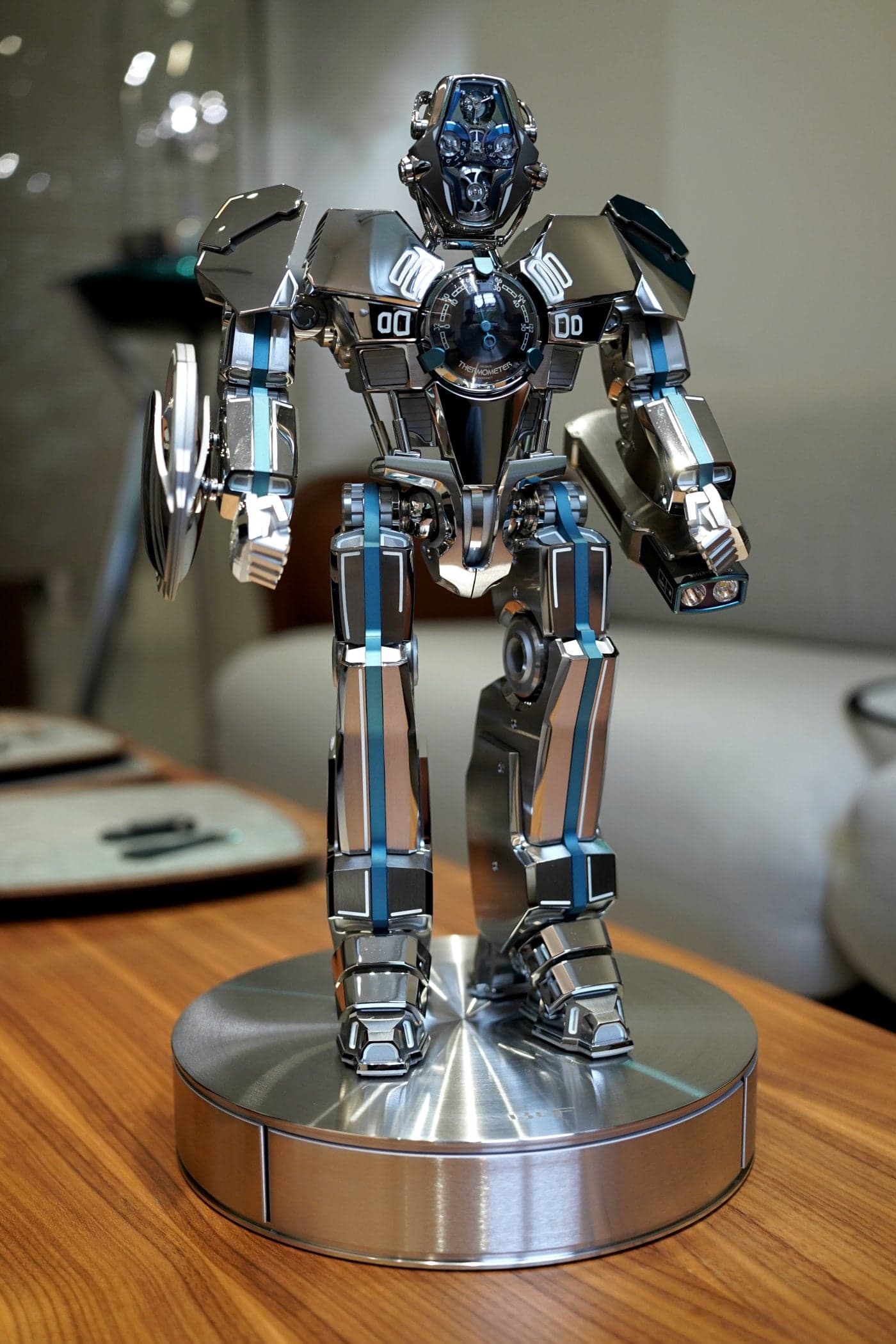
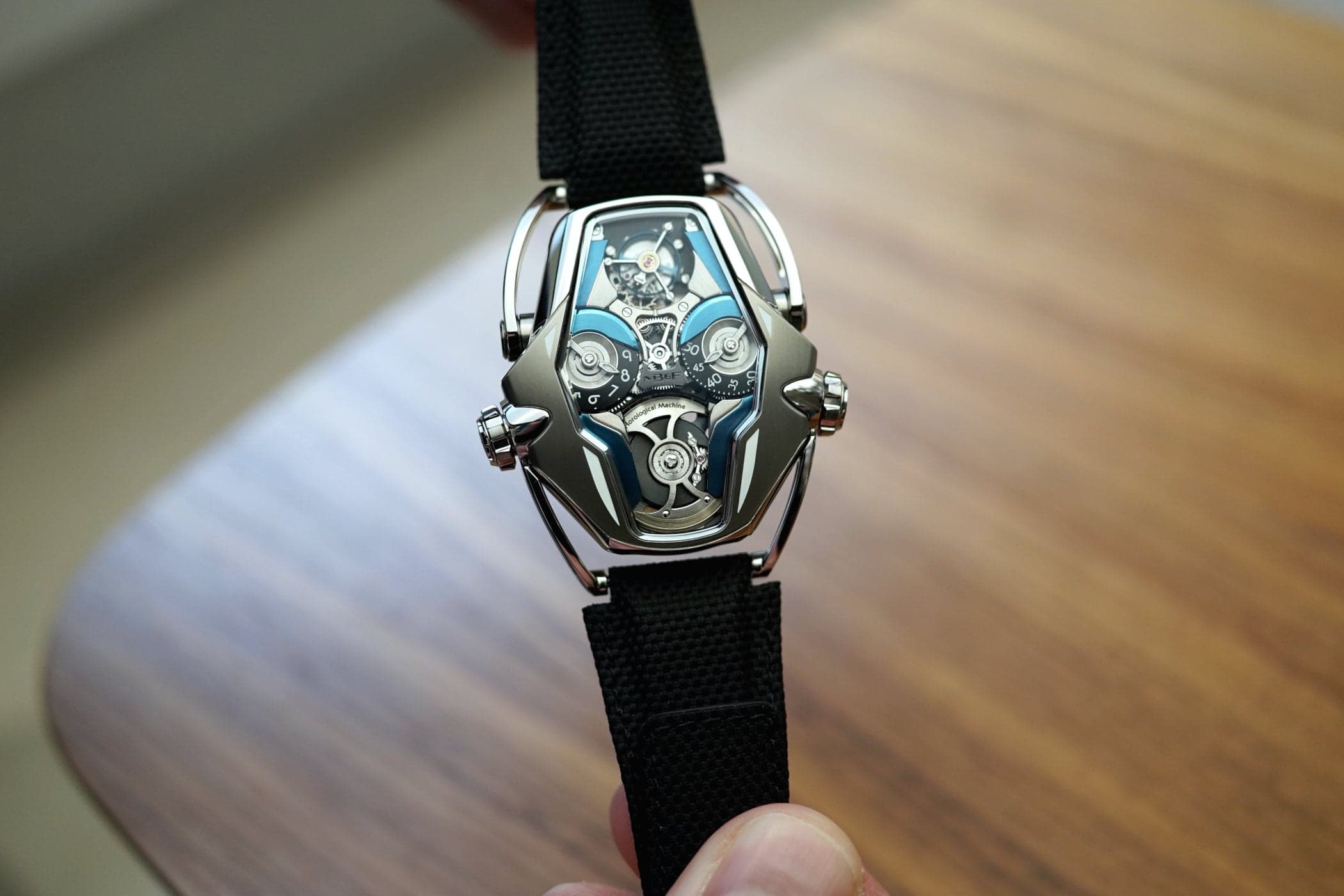
On 10 June 2026, MB&F unveiled the Horological Machine 12 "The Guardian" — its first new Horological Machine in years and arguably the most significant launch of the brand's third decade. The HM12 is a flying-tourbillon wristwatch shaped as a robot's head, and it ships with a mechanical body: a 38.2 cm, roughly 15 kg robot companion built by clockmaker L'Épée 1839, onto which the watch mounts to become a complete automaton-like sculpture. Just 36 pieces will exist — 12 each with blue, green or purple accents — at CHF 280,000 before taxes according to SJX (MB&F's official price was still listed as to-be-confirmed by Monochrome at publication).
The HM12 matters beyond its spectacle. It is the first Horological Machine conceived entirely by founder Maximilian Büsser and creative director Maximilian Maertens, without long-time designer Eric Giroud — a deliberate, public rehearsal of the brand's future leadership, executed in titanium and sapphire.
Design
The case is Grade 5 titanium, 49.3 mm long, 43.6 mm wide and 13.8 mm thick, built from 84 parts and crowned by three sapphire crystals (top, back and a lateral window at 12 o'clock that exposes the tourbillon from the side). The robot's face is the dial: a jumping-hours disc forms the left eye, trailing minutes the right, and the open mouth below reveals one side of the double-sided micro-rotor shaped like MB&F's battle-axe. Articulated lugs at 12 o'clock and a quick-release Velcro strap let the watch "re-capitate" the robot body. A second crown on the left flank drives the party trick: mechanical face shields that slide progressively across the dial, stoppable at any position to change the robot's expression.
The Guardian robot itself — brushed and polished with Super-LumiNova highlights — carries a bimetallic thermometer in its chest, a magnifying loupe in one arm, a detachable UV torch in the other, and a hidden strap drawer in its base.
Specifications
- Model: MB&F Horological Machine 12 "The Guardian"
- Case: 49.3mm × 43.6mm × 13.8mm, Grade 5 titanium, 84 components, three sapphire crystals
- Water resistance: 30m
- Movement: new in-house automatic calibre, 646 components, 86 jewels
- Functions: jumping hours, trailing minutes, flying tourbillon, mechanical face-shield system (200+ dedicated components, independent of the movement)
- Winding: automatic, double-sided micro-rotor; rear mass engine-turned by Brodbeck Guillochage (Kari Voutilainen)
- Frequency: 21,600 vph (3 Hz)
- Power reserve: 84 hours
- Strap: Velcro textile with quick-release, 20mm
- Robot companion: L'Épée 1839, 755 components, 382mm tall, 220mm base, ~15 kg, bimetallic thermometer, loupe, UV torch
- Limited edition: 12 pieces per colour (blue, green, purple) — 36 total
- Price: CHF 280,000 before taxes (per SJX; officially to be confirmed)
- Availability: MB&F retailers and M.A.D. Galleries
What's Exciting
This is a succession plan you can wind. Max Maertens — Büsser's designated creative heir — modelled the entire robot himself in SolidWorks, and the result reads as proof that MB&F's imagination survives its founder's eventual retirement. Mechanically, the face-shield system is the headline: more than 200 components doing something horologically useless and emotionally irresistible, with a declutching crown reminiscent of Patek Philippe's dynamometric winders so you cannot break it by over-cranking. Add a brand-new 646-part shaped calibre with an 84-hour reserve and a rotor guillochéd in Kari Voutilainen's workshop, and the HM12 is simultaneously a toy, a manifesto and serious haute horlogerie.
History
MB&F was founded in 2005 by Maximilian Büsser as a "concept laboratory", and the Horological Machine series — starting with HM1 in 2007 — built its reputation on sci-fi shapes drawn from childhood memories. The robot theme runs deep: the L'Épée-built desk clocks Melchior (2015), Balthazar (2016) and Grant (2018) were robots with clock hearts. HM12 closes that loop by finally putting the robot on the wrist. It arrives just after the brand's 20th anniversary and stands as the first Machine of the post-Giroud era — the work of two Maxes, one legacy.